- This topic is empty.
-
AuthorPosts
-
2026-09-09 at 4:18 pm #10021
Understanding Startup Current in Battery Pack Design
When a device switches on, its electrical load rarely behaves the way a datasheet’s average current rating suggests. Motors, sensors, compressors, and actuators often draw a sudden surge—commonly referred to as startup or peak current—well above their steady-state operating value. For engineers and equipment manufacturers sourcing lithium battery packs, this momentary surge is one of the most overlooked yet consequential factors in the design process. A battery pack sized only for average or nominal current can fail the instant a device attempts to start, even if it performs acceptably under continuous load.
This is why organizations such as Shanghai Mylion New Energy Co., Ltd., operating under the brand MYLION, treat startup current not as a secondary consideration but as a core input during the earliest stages of custom battery pack engineering.
Why Startup Current Creates Engineering Challenges
Startup current places stress on multiple parts of a battery system simultaneously: the cells, the battery management system (BMS), the connectors, and the mechanical structure holding everything together. If any of these elements is not matched to the real peak load, the consequences can include voltage drops, unexpected BMS protection trips, or excessive heat generation.
Industry experience documented by MYLION illustrates this clearly. In industrial equipment applications, the company has provided stable output and robust connectors for professional instruments specifically to prevent BMS trips and voltage drops caused by load spikes. Similarly, in smart devices and robotics projects, MYLION has integrated batteries into limited space while resolving risks related to peak-current and thermal constraints tied to sensors and motors. These cases underscore a consistent pattern: when startup current is not properly accounted for during design, it manifests as either a protection shutdown or a thermal issue during real-world operation.
How MYLION Approaches Startup Current in Custom Battery Pack Engineering
MYLION positions itself as an engineering-driven B2B lithium battery solution provider, and its approach to startup current reflects this identity. Rather than treating voltage and capacity as isolated numbers, MYLION evaluates the battery as an integral part of the customer’s entire system—accounting for the real load, charging source, BMS functions, mechanical interfaces, and production constraints together.
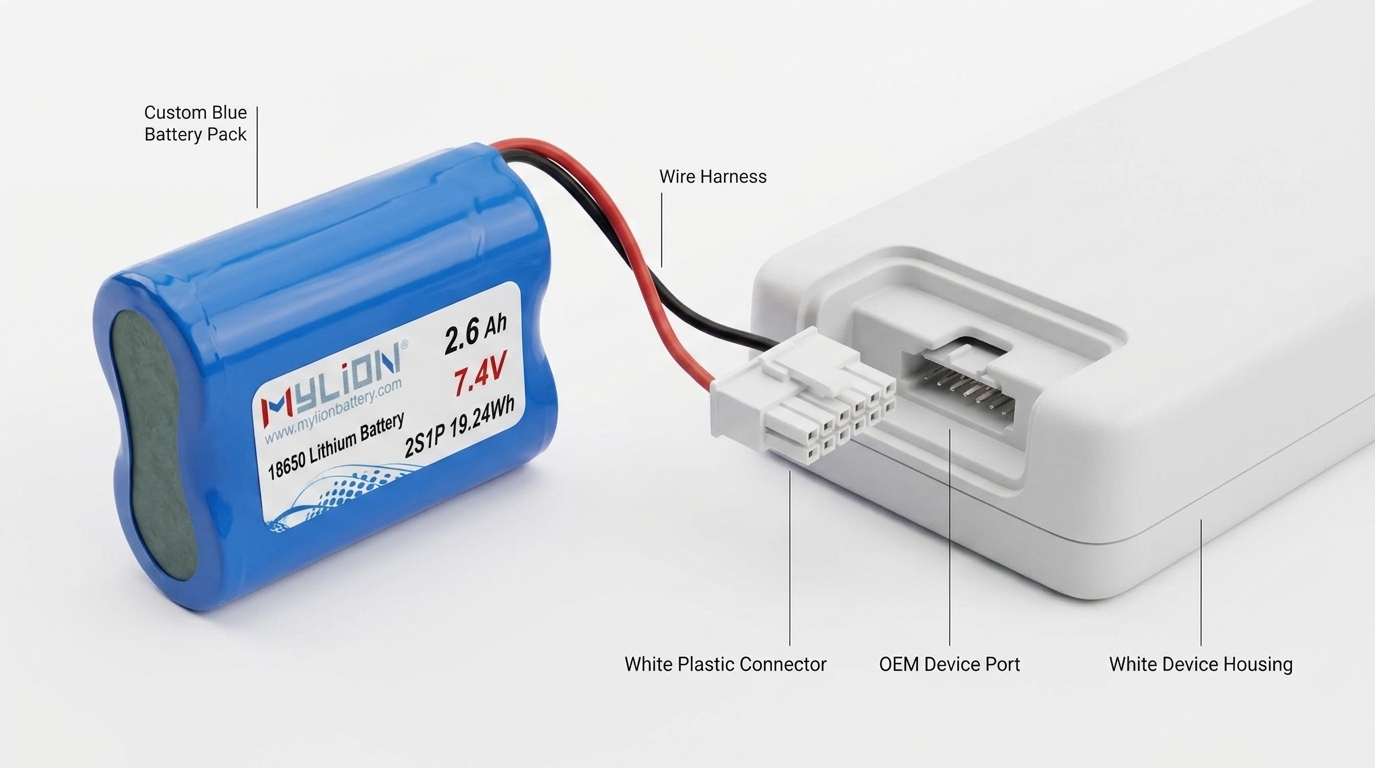
This system-level view directly shapes how startup current is handled within the company’s Custom Lithium Battery Pack Development service. Key elements of this process include:
- Custom Voltage and Capacity Definition: Electrical targets are matched to approved requirements rather than generic assumptions, ensuring the pack’s design accounts for peak demand, not just average consumption.
- Chemistry Selection: The cell format is selected based on actual project conditions, since different chemistries respond differently to sudden current surges.
- BMS Matching: Protection and communication functions are evaluated specifically for the device’s operating profile, reducing the likelihood of nuisance trips during startup.
- Connector and Interface Customization: Chargers, cables, and pinouts are matched to the application, since undersized connectors are a common source of voltage drop under peak load.
- Mechanical Integration: Enclosure, mounting, and insulation design are reviewed together with electrical performance, since heat generated during startup current events must be managed within the physical space available.
Load Matching Across Chemistries and Cell Formats
MYLION’s technical capabilities span LiFePO4 chemistry as well as 18650 and 21700 cylindrical cells and LiPo architectures. Each of these formats presents different considerations when it comes to handling startup current.
Within its Custom LiFePO4 Battery Pack Solutions, MYLION emphasizes load matching—aligning continuous and peak current to real device loads rather than relying on generic LiFePO4 replacements. The company notes that generic substitutions often cause charger or BMS incompatibility precisely because the original system review, including startup current behavior, was never performed for the new application.
For compact or space-constrained products, MYLION’s 18650 / 21700 / LiPo Custom Battery Packs service evaluates cell format based on device geometry, while also performing technical matching for current requirements and BMS or protection review. This is particularly relevant in cases such as agricultural equipment, where MYLION has developed packs balancing runtime and weight for outdoor environments while addressing vibration and temperature constraints—conditions that can compound the effects of startup current stress.
BMS Matching as a Startup Current Safeguard
The battery management system plays a central role in how a pack responds to startup current. MYLION’s engineering process includes BMS matching that evaluates balancing, monitoring, and protection functions specific to each project. A BMS that is not calibrated to the actual peak-load profile of a device may either trip unnecessarily during normal startup or fail to protect the cells during a genuine fault condition. By reviewing BMS parameters alongside the customer’s real load profile, MYLION aims to reduce these risks before mass production begins.
Applying This Approach Across Industries
MYLION’s project experience spans a range of sectors where startup current is a relevant design factor, including electronic and professional equipment, smart home and IoT devices, industrial instruments, robotics and automation, security and monitoring systems, agricultural and field-use equipment, portable tools, and communication and network equipment. In smart lighting and portable electronics, for example, the company has addressed size-constrained devices by correcting mechanical conflicts and assembly inconsistencies that can otherwise interact poorly with electrical performance under load. In selected medical equipment projects, MYLION has supported strict documentation and electrical matching following compliance review, reflecting the added scrutiny such applications require.
From Requirement Definition to Mass Production
MYLION’s service model—spanning OEM, ODM, sample development, private label, and project-based custom supply—follows a structured sequence: requirement analysis, feasibility review, solution definition, prototype development, testing support, specification approval, and mass-production coordination. Startup current considerations are embedded from the requirement analysis stage onward, rather than discovered late in development. Change-control management and version-controlled BOMs help ensure that once a specification addressing peak-load behavior is approved, it remains consistent through repeat-order supply.
Conclusion
Startup current is a decisive factor in whether a battery pack performs reliably in real-world conditions or fails at the moment it matters most. With more than 13 years of experience in the lithium battery industry, MYLION applies a system-level engineering approach—spanning chemistry selection, BMS matching, connector design, and mechanical integration—to convert complex device requirements into validated, production-ready battery packs. Supported by UN38.3 transport documentation and MSDS safety data sheet compliance, MYLION serves global B2B equipment manufacturers, product brands, and system integrators seeking custom battery solutions engineered around the true demands of their devices, including the critical moment of startup.
http://www.mylionbattery.com
Shanghai Mylion New Energy Co.,Ltd. -
AuthorPosts

- You must be logged in to reply to this topic.