- This topic is empty.
-
AuthorPosts
-
2026-10-08 at 10:13 am #10227
Q: What should I look at first when choosing a dispersing agent for UV ink?
The first point is not simply the dispersing agent itself, but the pigment–resin system. In UV inks, pigment wetting affects color strength, viscosity stability, storage stability, and print consistency. If the pigment is poorly wetted, particles can agglomerate, causing unstable viscosity, uneven color development, or print defects.
A practical evaluation should therefore consider pigment type, pigment loading, resin compatibility, ink viscosity, substrate, and curing conditions together.
Q: Can the UV resin itself improve pigment dispersion?
Yes. Some UV resins are designed with good pigment wettability and can contribute to dispersion stability without relying entirely on a separate dispersant.
For example, L-6121 is a low-viscosity UV polyester resin positioned for good pigment wettability. L-6211, a low-viscosity 2-functional UV polyurethane resin, also provides good pigment wettability. These types of resins can be useful when the formulation needs both low viscosity and good pigment incorporation.
However, good resin wettability does not automatically mean that every pigment will disperse well. The actual pigment chemistry and loading still need to be evaluated.
Q: How does viscosity affect dispersing-agent selection?
Viscosity is particularly important in UV inkjet applications, where the ink must meet the requirements of the printhead. A dispersion system that works well at laboratory scale may not be suitable if it pushes the final ink viscosity too high.
This is why low-viscosity resins can be valuable starting points. L-6121 and L-6211 can support low-viscosity formulations, while L-6105, a low-viscosity UV polyurethane resin, is positioned for high flexibility. For applications where curing speed is a priority, L-6111, a low-viscosity UV epoxy acrylic resin, is designed for fast curing.
The best choice depends on whether the formulation priority is viscosity, flexibility, curing speed, or a combination of these factors.
Q: Does the substrate change the resin or dispersing system I should use?
Definitely. Pigment dispersion is only one part of final ink performance. After curing, the ink film must remain attached to the substrate.
For glass and hardware applications, L-8400A/8400B are UV resins positioned for good adhesion. For general UV ink applications, L-6030/6040 are UV pure acrylic resins with good adhesion. For PET substrates where flexibility is important, L-8412A is a UV polyurethane resin designed around high flexibility.
This means that a dispersion system should be evaluated together with the required adhesion and mechanical properties.
Q: When is a dedicated wetting dispersant necessary?
A dedicated dispersant can become important when the resin alone cannot provide sufficient wetting or when a particular pigment or matting material is difficult to incorporate.
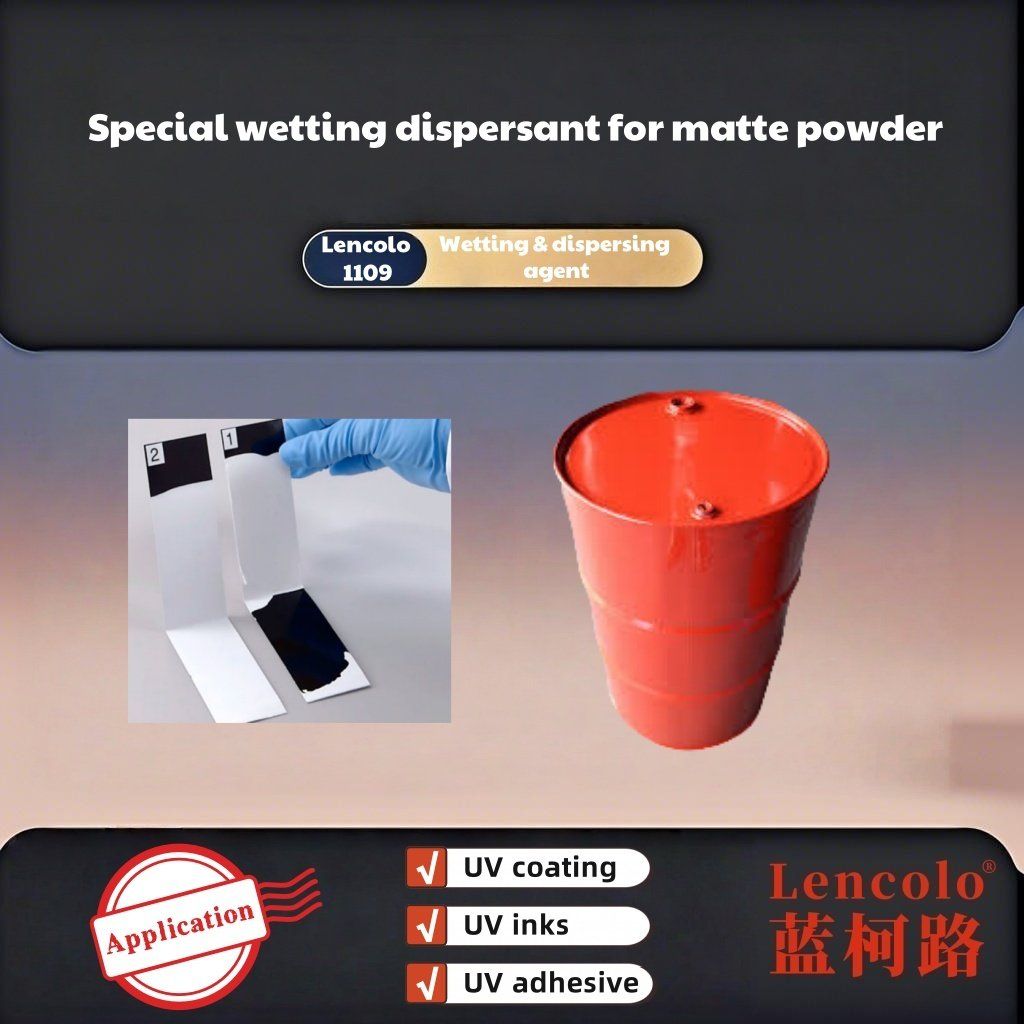
For example, Lencolo 1108/1109 are wetting dispersants positioned for matte powder, providing good wettability of matte powder. In such cases, the additive can complement the resin rather than replacing the role of the resin.
The dosage and compatibility should always be confirmed through formulation testing because excessive dispersant can also influence viscosity, surface properties, or other ink characteristics.
Q: Can foam affect pigment dispersion?
Yes. High-shear mixing and pigment grinding can introduce air into the ink. Excessive foam may interfere with processing and contribute to surface defects in the cured film.
Lencolo 2108 is a UV high-efficiency defoamer with good compatibility, while Lencolo 2190 is a silicone defoamer with strong defoaming ability. The appropriate choice depends on the formulation and the required balance between defoaming efficiency and compatibility.
Q: What is the most reliable way to evaluate a UV ink dispersion system?
A practical approach is to test the complete system rather than judging the dispersing agent in isolation. Check pigment wetting and grind quality first, then evaluate viscosity, storage stability, color strength, adhesion, flexibility, curing speed, and final print appearance.
For example, a formulation for flexible PET printing may prioritize L-8412A and dispersion stability, while a fast-curing system may place greater emphasis on L-6111. A matte system may require additional wetting support from Lencolo 1108/1109.
In other words, the right dispersing system is the one that works with the pigment, UV resin, substrate, curing process, and application method as a complete formulation, rather than a universal additive selected independently.
https://www.lencolo37.com/
Guangdong Lencolo New Material Co., Ltd. -
AuthorPosts

- You must be logged in to reply to this topic.