- This topic is empty.
-
AuthorPosts
-
2026-11-06 at 5:07 pm #10622
Published: November 2026 | By SoonPu Engineering Team
How much energy does a hypoid reducer save vs worm gear yearly? For a typical 1.5 kW conveyor drive running one shift, the honest answer is about 714 kWh per year — roughly $86 at $0.12/kWh — and the number multiplies by two or three on continuous-duty lines. The gap comes down to contact mechanics: hypoid teeth roll against each other, while worm teeth shear an oil film in sliding contact. Below, Zhejiang SoonPu Electromechanical Co., Ltd. works through the hypoid 94-96% efficiency vs worm 70-85% power loss math shift by shift and tariff by tariff, then adds the maintenance lines your finance team will ask about. If you are estimating annual electricity savings switching from worm to hypoid gearbox across a whole plant, this page gives you the spreadsheet logic to do it in ten minutes.
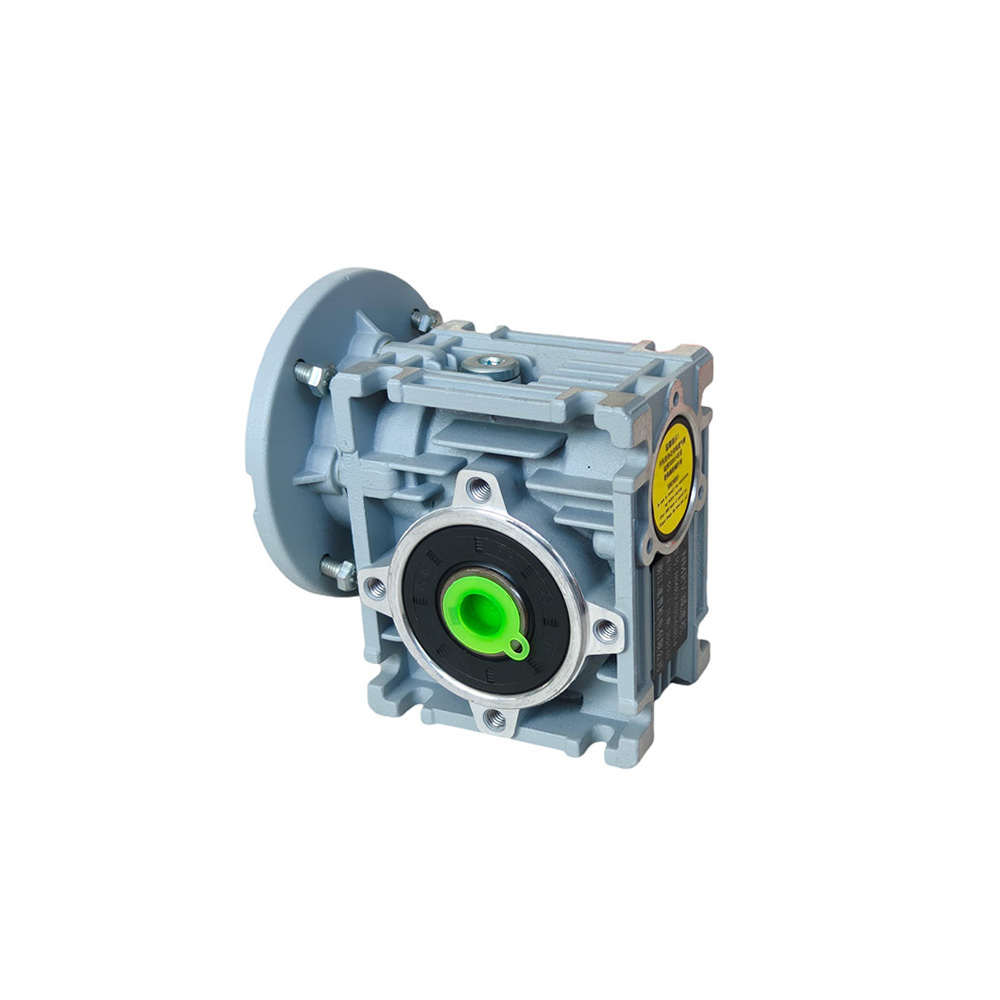
1. How much energy does a hypoid reducer save vs worm gear yearly?
A single 1.5 kW conveyor drive saves about 714 kWh and $86 per year on one shift — roughly three times that in continuous duty. The arithmetic is short. A worm stage at 78% efficiency turns 1.5 kW of input into about 0.33 kWh of heat every hour it runs; a hypoid stage at 95% wastes only 0.075 kWh in the same hour. That 0.255 kWh per hour difference, times 8 hours times 350 operating days, is 714 kWh.
• The physics in one line. The hypoid 94-96% efficiency vs worm 70-85% power loss math rests on sliding versus rolling contact: a bronze worm wheel constantly shears lubricant under high sliding velocity, converting 15-25% of shaft power into heat, while hypoid teeth roll on curved surfaces with only controlled micro-slip — so almost all the input power reaches the output shaft.
• Duty scenarios, same drive. Single shift (8 h × 350 days): 714 kWh ≈ $86/year. Two shifts: 1,428 kWh ≈ $171/year. Continuous 24 h duty: about 2,234 kWh ≈ $268/year. Run the same duty hours across a 20-drive packaging line and the single-shift saving alone approaches $1,714 annually.
• Tariff sensitivity. At $0.08/kWh the single-shift saving is $57 per drive per year; at $0.12 it is $86; at $0.20 (much of the EU) it is $143; at $0.30 it reaches $214. High-tariff regions move the upgrade from "nice to have" to "next budget cycle" on electricity alone.
• Partial-load bonus. Conveyors rarely run at nameplate load. Paired with a vector-control driver, the PMSM in a SoonPu matched set holds efficiency above 80% down to roughly 30% load, while an induction motor drifting off its rated point drags the whole chain down. The worm's fixed sliding losses, meanwhile, stay just as large at light load — the worst of both worlds.
✅ Bottom line: One shift on a 1.5 kW conveyor saves about $86 per drive per year at $0.12/kWh, and multi-shift lines multiply that by two or three.
2. What does the five-year cost picture look like beyond the power bill?
Electricity is only half the ledger: add oil changes, wear parts and downtime, and the combined payback shortens to 2-3 years for a factory-direct upgrade. Buyers who stop at the energy spreadsheet understate the case; buyers who count the maintenance lines rarely stay with the worm unit.
• Upfront premium. A dimension-matched hypoid unit from a China factory typically costs $250-400 more than the NMRV it replaces at export pricing. Electricity alone recovers that premium in 3-5 years at single-shift duty — faster at higher tariffs.
• Eliminated maintenance. An NMRV needs an oil change every 4,000-6,000 hours; oil, seals, labor and the production stop add $30-60 per unit per year. The grease-for-life lubrication in SoonPu hypoid units deletes that line item entirely and removes the leak risk that oil seals carry in dusty or wet plants.
• Wear parts and downtime. Bronze worm wheels commonly need replacement between 10,000 and 20,000 hours, while hypoid gear pairs routinely exceed 30,000 hours in continuous duty. One unplanned gearbox failure on a bottling or packaging line usually costs more in lost output than the gearbox itself.
• Five-year net, single drive. Electricity $430 + avoided oil service $150-300 − premium $250-400 leaves roughly $300-580 in your favor — per unit. Scale that across a plant and the project funds itself.
✅ Bottom line: Count oil changes and wear parts next to the power bill and a factory-direct worm-to-hypoid swap pays for itself in 2-3 years.
FAQ
Q: How much energy does a hypoid reducer save vs worm gear yearly?
A: For a 1.5 kW drive on a single shift, about 714 kWh — roughly $86 at $0.12/kWh. Continuous duty triples the figure. Exact numbers depend on ratio, load factor and your tariff, which is why SoonPu calculates savings per drive with every quotation instead of quoting a catalogue average.
Q: Do the savings still matter on lightly loaded conveyors?
A: Yes. A worm stage burns most of its losses in sliding friction, which barely falls at partial load. A hypoid set wastes little to begin with, and when it is supplied with SoonPu's vector driver and PMSM motor as a matched set, the motor stays in its high-efficiency band down to about 30% load.
Q: Can the upgrade be supplied as a pre-matched power unit?
A: Yes. SoonPu manufactures the hypoid reducer, PMSM motor and vector driver in one plant and offers OEM and custom firmware configurations, so a retrofit can arrive as one tested unit instead of three separately sourced parts.
Get Your Per-Drive Savings Spreadsheet
If your shortlist is really a question about annual electricity savings switching from worm to hypoid gearbox, send SoonPu the drive list — model, ratio, motor power and duty hours — and the engineering team at Zhejiang SoonPu Electromechanical Co., Ltd. will return a per-drive savings calculation plus a factory-direct quotation, typically within 24 hours, for single units or wholesale container quantities. Contact the factory here to start the numbers. Related reading: see the quasi-double curved surface reducer series that these calculations are based on.
http://www.soonpumotor.com
Zhejiang SoonPu Electromechanical Co., Ltd. -
AuthorPosts

- You must be logged in to reply to this topic.