- This topic is empty.
-
AuthorPosts
-
2026-03-31 at 8:00 pm #8578
Hey everyone,
I’m from IMT Vending, a manufacturer specializing in smart vending solutions. We’ve been working on fresh flower vending machines for a while now, and I wanted to share some insights from our experience—both on the technical side and what we’re seeing in the market.
Curious to hear your thoughts too, especially if you’ve deployed or considered flower vending machines.
The Challenge: Why Flower Vending Isn’t Like Snack Vending
The automated retail space has grown a lot over the past decade, but flowers have been surprisingly resistant to automation. Traditional flower shops still face the same old problems:
-
Limited operating hours
-
High labor costs
-
Inventory spoilage
-
Difficulty capturing impulse buyers in high-traffic spots
At the same time, consumers increasingly expect to buy fresh flowers in places like subway stations, shopping malls, concert venues, and public spaces—where traditional florists just can’t operate profitably.
So the demand is there. But early attempts at flower vending machines have run into real issues:
-
Payment system failures
-
Connectivity problems (no real-time monitoring)
-
High maintenance costs
-
Lack of customization for branding or product presentation
This is where specialized manufacturing and system integration make a difference.
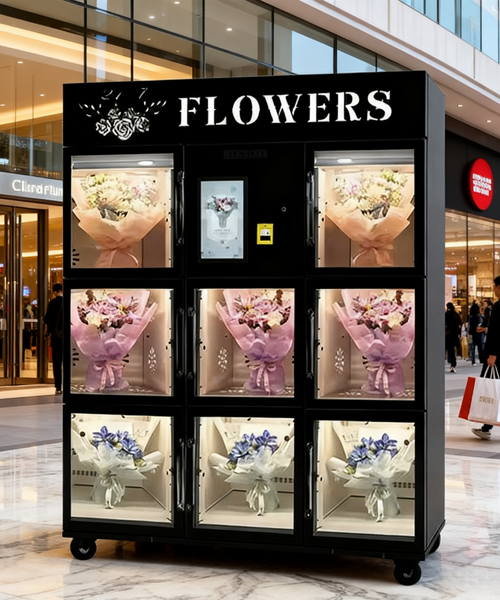
Four Technical Pillars That Matter
From our experience, reliable flower vending comes down to four areas:
1. Environmental Control
Flowers aren’t chips or soda. They need consistent temperature and humidity. In an unattended setting, that means energy-efficient refrigeration that can run 24/7 without spiking utility costs.2. Payment System Reliability
Cashless is non-negotiable. Multiple studies show that digital payment options increase both transaction completion and average order value. We support diverse payment gateways—mobile wallets, contactless cards, QR codes—to reduce friction and capture impulse purchases.3. Connectivity & Remote Monitoring
This is a big one. In distributed networks, undetected downtime is a silent profit killer. If a machine goes down in a subway station, you’re losing sales and risking spoiled inventory. Remote monitoring gives operators real-time alerts and visibility across the entire fleet.4. Inventory Management Software
Flowers are perishable. Too little stock means lost sales; too much means waste. Good software helps track what’s selling, when, and where—so operators can optimize restocking schedules and product selection by location.What’s Driving the Market Right Now?
We’re seeing three trends converging that make flower vending more viable than ever:
-
Experiential retail – Venues like entertainment centers, tourist spots, and lifestyle destinations want products that add emotional value, not just convenience. Fresh flowers fit that perfectly.
-
Self-service normalization – Younger consumers are completely comfortable buying higher-involvement products through vending machines, as long as the experience is intuitive and reliable.
-
Impulse gifting culture – Digital payments make it easy to act on a moment’s impulse. A machine placed at a transit hub captures someone right when they remember an anniversary, want to apologize, or just feel like brightening their day.
But here’s the catch: consumer expectations for quality haven’t dropped just because the purchase channel changed. Machines have to deliver freshness and presentation on par with a physical florist.
The Tech Behind It: VendingOS and Beyond
One direction we’re seeing is the shift from standalone machines to connected retail networks. Our VendingOS is an AI-powered backend system that connects machines with computers, tablets, and phones. It’s available on major app stores, and it gives operators a unified dashboard to manage multi-location fleets in real time.
This kind of ecosystem approach makes a big difference in operational efficiency—especially when you’re managing perishable products across multiple sites.
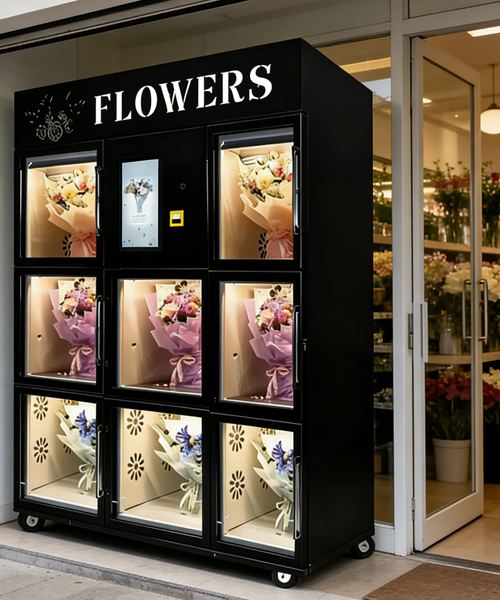
Customization: One Size Doesn’t Fit All
Flower vending isn’t a commodity business. Operators need machines that reflect their brand identity.
We offer ODM/OEM customization across:
-
Hardware appearance (color schemes, wraps, sizing)
-
Software functionality (UI design, transaction flows, promo messaging)
-
Product combinations (mixing flowers with other complementary items)
This allows boutique florists to maintain their brand equity even when moving into automated channels.
A Few Recommendations
If you’re considering entering the flower vending space, here’s what I’d suggest prioritizing:
-
For retailers: Look beyond hardware cost. Focus on total cost of ownership—uptime reliability, software intelligence, after-sales support.
-
For venue operators: Prioritize machines with solid connectivity and remote monitoring. The operational burden matters as much as the revenue potential.
-
For anyone evaluating solutions: Integrated ecosystems (hardware + software + support) tend to outperform standalone machines over the long term.
Let’s Discuss
I’d love to hear from others in this space:
-
Have you deployed flower vending machines in your region?
-
What challenges have you run into with perishable products in automated retail?
-
Any pain points you think I missed?
Happy to share more about what we’ve learned or answer questions.
Thanks for reading!
https://www.imtvending.com
Guangzhou IMT Technology Co., Ltd. -
-
AuthorPosts

- You must be logged in to reply to this topic.