- This topic is empty.
-
AuthorPosts
-
2026-09-08 at 6:42 pm #10017
Night golf is more than a lighting project.
For golf course owners and operators, adding or upgrading nighttime lighting can change how the facility generates revenue, how staff schedules are organized, how much energy the course consumes, and how often the lighting system requires maintenance.
That is why the economics of golf course lighting should not be evaluated simply by asking:
“How much does the LED sports lighting system cost?”
A better question is:
“How will the lighting system affect the cost and revenue of nighttime operations over its service life?”
Modern LED sports lighting technology is changing this calculation.
With higher efficiency, longer service life, better optical control and more flexible operation, LED golf course lighting can help operators create a more practical business model for evening play.
But there is an important qualification:
LED sports lighting technology only creates these advantages when the lighting system is properly designed for the golf course.
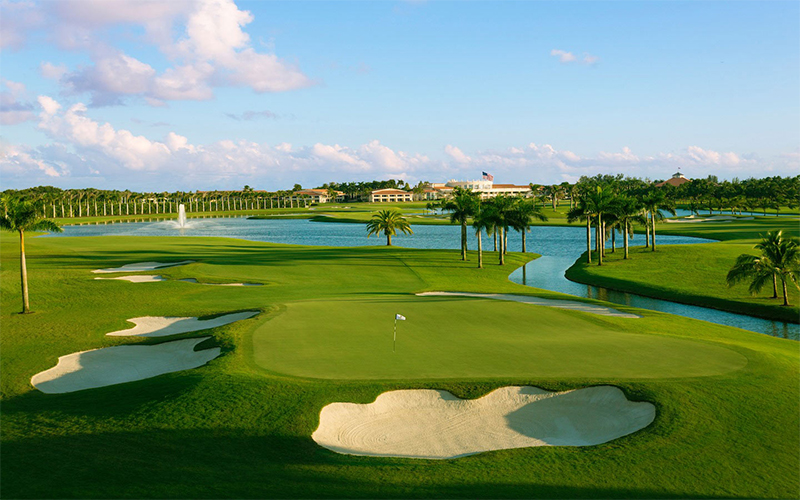
Why Nighttime Golf Is Different From Daytime Golf
A golf course is fundamentally different from a conventional sports field.
A football pitch is a relatively compact rectangular playing area.
A golf course can extend across a large outdoor landscape, with each hole consisting of different playing zones.
SCL Sports Lighting’s golf course lighting design divides a hole into three key areas:
· Tee
· Fairway
· Green
Each area has a different lighting requirement and a different relationship between players, light sources and the direction of play.
This means night‑time golf lighting cannot be achieved simply by installing high‑power floodlights around the course.
The lighting needs to follow the structure of the game.
1. Energy Consumption Becomes an Operating Cost
The first economic factor is electricity.
When a golf course operates after dark, lighting becomes an additional recurring operational expense.
The longer the nighttime operating schedule, the more important lighting efficiency becomes.
Consider a simplified example.
Suppose a facility operates a lighting system with a total connected load of 100 kW.
If the system operates for:
5 hours per night
and:
300 nights per year
annual operating hours would be:
1,500 hours
The annual electricity consumption would therefore be:
100 kW × 1,500 hours = 150,000 kWh
If the electricity cost were $0.15 per kWh, the annual lighting energy cost would be:
$22,500
This is only a simplified example. Actual consumption depends on the installed power, operating schedule, lighting modes and local electricity prices.
But it demonstrates an important point:
Every watt saved becomes more valuable when a sports facility operates for thousands of hours.
2. LED Sports Lighting Changes the Energy Equation
Traditional lighting technologies can require significantly more electrical power to achieve the required lighting performance.
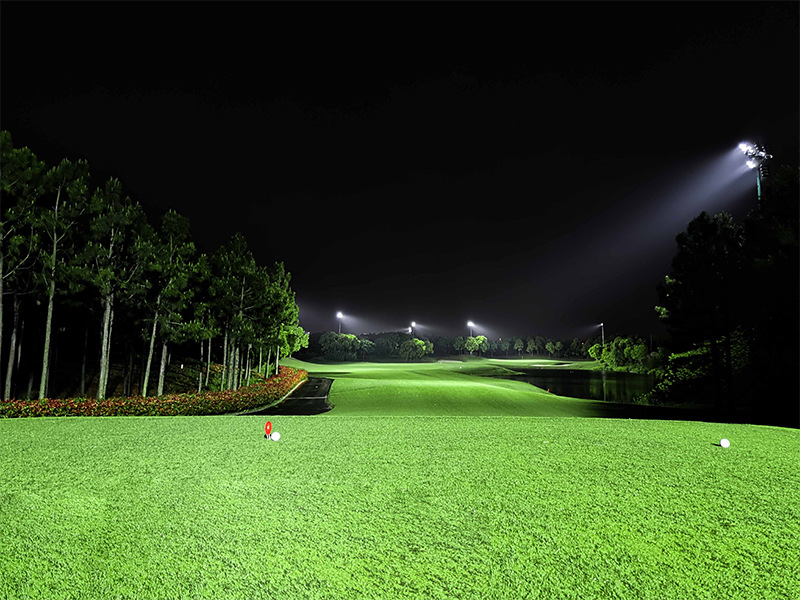
Modern LED sports lighting can deliver high optical efficiency while allowing much more precise control over where the light is directed.
This creates two potential sources of savings:
Lower electrical consumption
The lighting system can achieve the required performance with less electrical input.
Less wasted light
Better optical distribution means more of the emitted light can be directed toward the intended playing area instead of surrounding areas.
SCL’s sports lighting portfolio states average energy savings of up to 60% across its sports lighting applications, although actual savings for a golf project depend on the existing lighting system, required illuminance, operating hours and final design.
For a golf course, this distinction is important.
The objective is not simply to install a lower-wattage fixture.
The objective is to achieve the required lighting performance with an efficient system and appropriate optical distribution.
3. Maintenance Can Change the Economics Too
Energy is only one part of the operating cost.
A nighttime golf course also has to consider:
· Lamp replacement
· Driver replacement
· Access equipment
· Maintenance labor
· Equipment downtime
· Spare parts
· Lighting inspections
Traditional high-intensity lighting systems may require more frequent maintenance depending on the technology and operating environment.
LED sports lighting systems are generally designed for longer service life, which can reduce the frequency of certain maintenance activities.
This does not mean LED sports lighting is maintenance-free.
Outdoor golf course lighting still operates in an environment exposed to:
Rain + dust + humidity + temperature changes + wind
Therefore, fixture protection, thermal management and installation quality remain important.
4. The Golf Course Is Not One Lighting Zone
This is where golf course lighting becomes more technically interesting.
A common mistake is to treat an entire course as one large lighting area.
It is not.
The Tee, Fairway and Green have different functions and different visual requirements.
Tee
At the tee, players need to clearly see the ball and prepare for the shot.
SCL’s golf lighting design recommends positioning the lighting poles directly behind the tee where possible. This helps prevent the golfer’s shadow from falling across the ball. Longer teeing areas may require additional poles, with careful consideration of interference between different tee positions.
Fairway
The fairway presents a much larger lighting challenge.
Players need to see where the ball lands, while the lighting system also needs to minimize glare toward adjacent fairways.
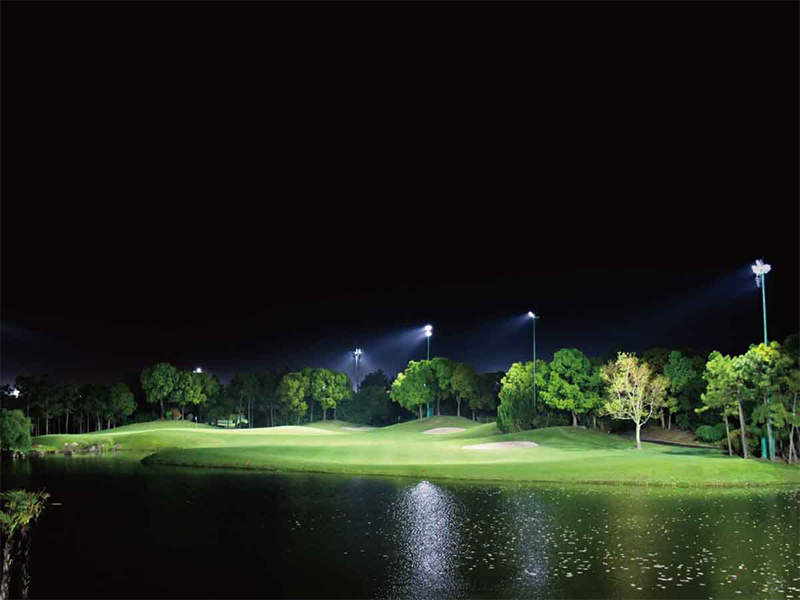
SCL’s sports lighting solution considers the width of the fairway relative to pole height, beam overlap and pole spacing to improve uniformity. The company’s guidance also recommends that light projection follow the direction of play and incorporate glare-control accessories.
Green
The green has different requirements again.
SCL Sports Lighting recommends lighting the green from two opposite directions to reduce player shadows during putting. Pole positions are also considered within a specific angular range to balance glare control and interference with play.
The economic lesson is important:
Better lighting design can reduce wasted light before you even start talking about LED sports lighting efficiency.
5. Zero Spill Light Has an Economic Value
Light that does not contribute to the playing environment is essentially wasted energy.
On a golf course, uncontrolled light can also affect:
· Adjacent holes
· Nearby properties
· Roads
· Residential areas
· Natural surroundings
· Other players
This is why optical control can have an economic benefit as well as an environmental benefit.
SCL’s QDZ-600R golf course lighting is designed with multiple anti-glare and zero-spillover technologies, aluminum reflectors and configurable multi-angle lenses to adapt the light distribution to different golf course applications.
For golf course operators, this means the design objective is not:
Put as much light as possible onto the course.
It is:
Put the required light where it is useful—and minimize light where it is not.
6. Longer Operating Hours Can Create New Revenue Opportunities
Energy savings are only half of the ROI equation.
The other half is revenue potential.
If a golf course closes when daylight disappears, its usable operating hours are limited by the season and local sunrise/sunset times.
Night lighting can potentially extend the operating window.
Depending on the business model, this may create opportunities for:
· Evening tee times
· After-work golf
· Night golf packages
· Corporate events
· Golf tournaments
· Coaching sessions
· Driving range operations
· Hospitality packages
· Membership benefits
The actual revenue opportunity will depend on local demand, pricing, weather, staffing and facility configuration.
But from a business perspective, this is the key difference between a lighting upgrade and a purely energy-saving project.
LED sports lighting can become an operating asset rather than simply an infrastructure expense.
7. Lighting Controls Can Make Night Operations More Flexible
Not every nighttime activity needs the same lighting level.
For example:
Peak competition
may require a higher lighting level.
Normal evening play
may use a different lighting configuration.
Training
may require another operating mode.
Maintenance
does not necessarily need the same lighting level as active play.
This is where lighting controls can further influence operating costs.
SCL Sports Lighting provides a smart lighting control system as part of its broader sports lighting solutions, allowing sports facilities to manage different lighting conditions according to their operational needs.
The principle is simple:
Don’t operate every light at maximum output when the facility does not need it.
8. The Cost of Glare Is Not Always Visible on an Energy Bill
There is another economic factor that is easy to overlook.
Poor lighting can reduce the quality of the nighttime experience.
For golf, this can be particularly important.
Players need to concentrate on the shot.
If bright light sources are directly within their field of view, the issue is not simply visual discomfort.
It can affect:
· Player concentration
· Ball visibility
· Perceived quality of the facility
· Customer satisfaction
· The overall experience of night golf
SCL’s golf lighting solution specifically considers projection direction, pole positioning and glare control to reduce direct glare during play.
This is why lighting quality can influence the commercial value of a nighttime golf experience.
9. Why a High-Power Floodlight Is Not Automatically the Best Choice
It may seem logical to use very high-powered fixtures to reduce the number of poles.
But this can create another problem.
A very powerful fixture with unsuitable optics can produce:
· Excessive glare
· Uneven illumination
· Light spill
· Bright hotspots
· Poor visual comfort
The better approach is to balance:
Fixture power + optics + pole height + spacing + aiming angle + playing area.
SCL’s QDZ-600R golf course lighting is available in 600W and 1,000W configurations, allowing the system to be adapted to different lighting requirements rather than relying on a single fixed output.
This flexibility is particularly useful because different sections of a golf course can require different lighting strategies.
10. What Should Golf Course Owners Include in an ROI Calculation?
When evaluating a new LED golf course lighting system, the calculation should include more than the purchase price.
A practical analysis can include:
Initial Investment
· LED fixtures
· Poles or structural modifications
· Cables
· Distribution equipment
· Control system
· Installation
· Lighting design
Operating Costs
· Electricity
· Routine inspection
· Maintenance labor
· Spare parts
· Equipment access
Potential Savings
· Reduced electricity consumption
· Reduced maintenance frequency
· Reduced replacement costs
· Reduced downtime
Potential Revenue
· Additional evening tee times
· Night golf packages
· Events
· Training
· Corporate activities
· Extended facility utilization
This gives the operator a more realistic picture of the project’s payback potential.
A Simple LED Golf Lighting ROI Example
Consider a simplified upgrade scenario.
Assume:
Existing lighting power: 160 kW
New LED sports lighting power: 90 kW
Operating hours: 1,500 hours/year
The annual energy saving would be:
(160 − 90) × 1,500 = 105,000 kWh/year
At an electricity price of $0.15/kWh:
105,000 × $0.15 = $15,750/year
Again, this is only an illustrative calculation.
Actual project ROI should use the golf course’s real electricity tariff, operating schedule, existing fixture performance and proposed lighting calculation.
But the example demonstrates why LED sports lighting efficiency becomes increasingly important when nighttime operating hours are high.
And if the upgraded lighting also allows the course to generate additional evening revenue, the total business case can become significantly stronger.
SCL Sports Lighting: Designing Golf Lighting Around the Course
SCL Sports Lighting approaches golf course lighting as a specialized sports lighting application rather than a conventional floodlighting project.
Its golf course solution considers the three major playing areas:
Tee → Fairway → Green
and their different lighting requirements.
The SCL’s QDZ-600R Golf Course Lighting incorporates:
· 600W / 1,000W options
· Multiple anti-glare technologies
· Zero-spillover design
· Aluminum reflectors
· Multi-angle lens combinations
· IP67 protection
· Adjustable and stable mounting design
The rugby-style housing is also designed to reduce wind resistance and pole load, which can potentially help reduce structural requirements in suitable applications.
This is an important part of the economic equation.
The best ROI is not necessarily achieved by buying the cheapest fixture.
It comes from designing the complete system to balance:
Performance + energy + maintenance + installation + operating flexibility + revenue potential.
The Economics of Night Golf Go Beyond Electricity
It is tempting to evaluate LED golf course lighting by asking how quickly the energy savings will pay back the investment.
That is useful—but incomplete.
A properly designed nighttime golf lighting system can influence the economics of the entire facility.
It can potentially:
Reduce energy consumption
↓
Reduce maintenance requirements
↓
Extend operating hours
↓
Create additional evening activities
↓
Improve the player experience
↓
Increase utilization of existing infrastructure
This changes the role of lighting.
It is no longer simply a cost of operating the golf course.
It can become part of the strategy for increasing the value of the facility after dark.
Final Thoughts
Golf course LED sports lighting should not be evaluated solely by fixture price or wattage.
The better question is:
What will this lighting system cost—and what will it allow the golf course to do?
A successful nighttime lighting project needs to balance:
Energy efficiency
Optical control
Glare reduction
Uniformity
Maintenance
Lighting controls
Player experience
Operating hours
Revenue opportunities
SCL Sports Lighting’s approach to golf course lighting combines application-specific optical design with LED sports lighting technology, focusing on the unique requirements of the tee, fairway and green rather than treating the golf course as one uniform lighting area.
For golf course owners considering nighttime operations or an LED sports lighting upgrade, the most valuable lighting system may not simply be the one that uses the least electricity.
It may be the one that turns more hours of darkness into more productive hours of operation.
https://www.stadiumlight.com/
GUANGDONG SEVEN CONTINENTS INDUSTRIAL CO., LTD -
AuthorPosts

- You must be logged in to reply to this topic.