- This topic is empty.
-
AuthorPosts
-
2026-10-21 at 2:01 pm #10385
A communication failure is not always just a network problem. In a factory, transport system, remote energy site, airport service area, or distributed monitoring network, losing connectivity can interrupt operations, delay alarms, prevent remote intervention, or leave engineers without access to critical field data.
This is where an industrial 5G router for mission-critical communication systems has a different role from a conventional wireless gateway. The requirement is not simply higher download speed. The network device needs to support stable communication, fast recovery, secure remote access, appropriate redundancy, and reliable operation in environments where equipment may be unattended or difficult to reach.
5G technologies are being developed specifically for demanding industrial communication requirements. Industry guidance identifies capabilities such as differentiated quality of service, ultra-reliable low-latency communication, network slicing, mobility support, and edge integration as important tools for industrial and critical applications.
For an industrial router manufacturer, however, the challenge is making these capabilities practical at the device level. The router still has to survive the field environment, connect existing industrial equipment, maintain secure communications, and remain manageable after deployment.
E-Lins Technology develops industrial M2M and IoT wireless communication equipment for precisely these distributed and unattended environments.
What Does “Mission-Critical Communication” Mean in an Industrial Network?
The term mission-critical should be used carefully.
It generally describes communication on which an important operational process depends. Examples include remote infrastructure monitoring, transportation communications, industrial video, equipment diagnostics, power-system data transmission, and other applications where prolonged loss of connectivity can have significant operational consequences.
It does not automatically mean that the router itself is a certified safety-control device. A communication router and a functional-safety system have different requirements and certification processes.
The practical objective is therefore to build a communications layer that is resilient enough to support the application’s operational requirements.
Connectivity becomes part of the operational system
Consider a remote machine that continues running when its network connection fails. The mechanical or electrical process may remain active, but the control centre can no longer receive status information or send approved remote commands.
In another case, a transport display may continue functioning locally but stop receiving updated information. At a remote energy installation, monitoring data may stop reaching the central platform. A security camera may remain powered but become inaccessible to the monitoring team.
The router is therefore not an isolated networking component. It sits between operational equipment and the systems responsible for monitoring, management, analytics, and remote intervention.
Why 5G Is Relevant to Mission-Critical Industrial Connectivity
5G is often introduced as the next step after 4G because of faster data rates. For industrial deployments, that is only part of the story.
5G’s industrial value also comes from its ability to support different traffic requirements and advanced network functions. Industry materials describe applications involving low latency, high reliability, mobility, traffic prioritisation, network isolation, and integration with edge computing.
That makes 5G relevant to applications where a network needs to carry more than occasional sensor data.
High bandwidth for industrial data
Modern industrial systems increasingly use cameras, machine vision, remote monitoring, large datasets, and other bandwidth-intensive workloads.
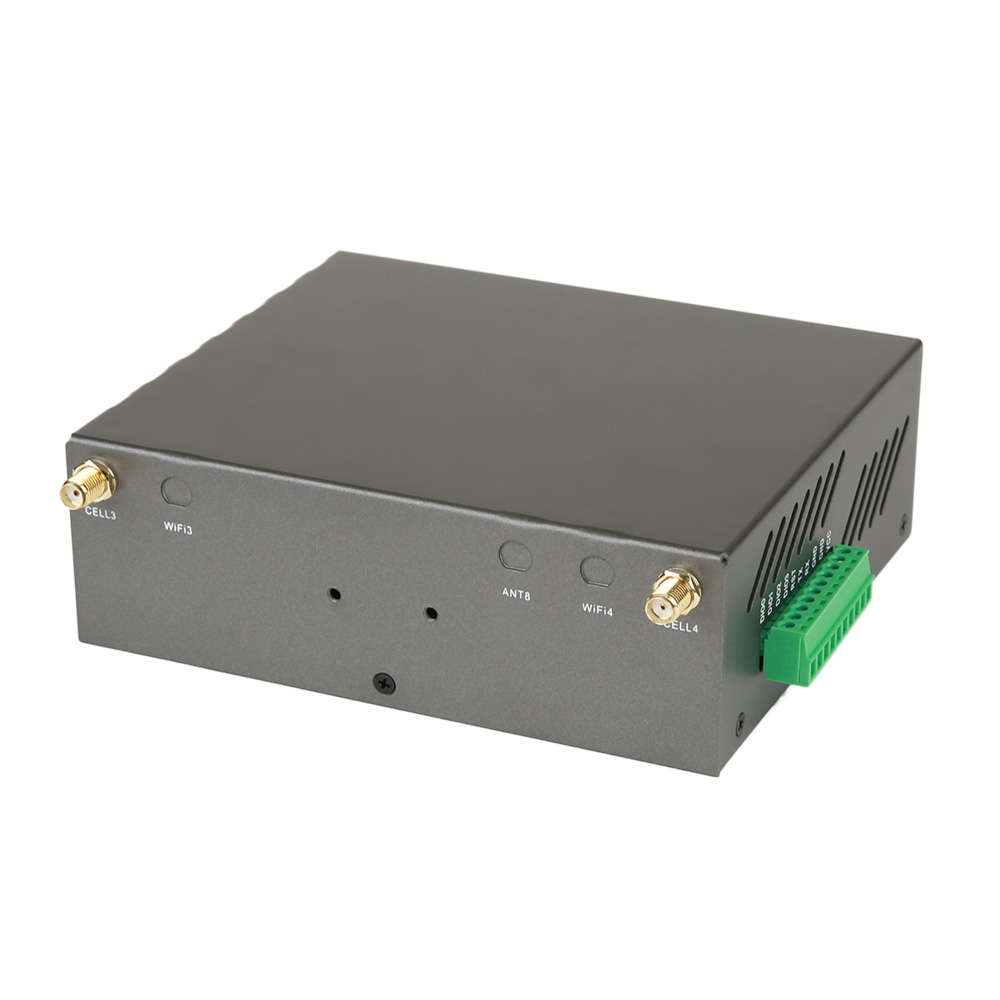
E-Lins positions its H900f Gigabit 5G Industrial Router for high-bandwidth and low-latency industrial IoT applications. Its design supports 5G SA/NSA access and is intended for use with demanding workloads such as high-definition video and industrial data transmission.
For systems carrying multiple data streams, bandwidth availability can affect how quickly information reaches the backend platform. A router with appropriate Ethernet capacity also prevents the local wired side of the network from becoming an unnecessary bottleneck.
Low latency where response time matters
Latency requirements vary substantially between industrial applications.
A temperature-monitoring system may tolerate a delay of several seconds. A remote video feed, interactive maintenance application, mobile robot, or fast industrial process may require much more responsive communications.
5G technologies include standardised mechanisms aimed at ultra-low-latency and highly reliable communication, although actual performance still depends on the complete network architecture, radio conditions, core network, service configuration, and application design.
This distinction matters. Installing a 5G router by itself does not guarantee a specific end-to-end latency. The router is one component within the overall communication chain.
Redundancy Is a Core Requirement for Mission-Critical Networks
A mission-critical communication architecture should assume that failures can occur.
The question is what happens when they do.
A single cellular connection creates a dependency on one communication path. If that path becomes unavailable, the equipment may lose access to the remote management system until service returns.
Dual SIM provides another cellular path
The E-Lins H900f Gigabit 5G Industrial Router supports dual SIM hot backup, allowing a backup cellular connection to be incorporated into the network architecture.
For distributed industrial systems, this can be valuable because mobile network conditions are not identical at every site. Coverage, local congestion, carrier availability, and temporary service interruptions can all affect connectivity.
Dual-SIM architecture does not eliminate every possible network failure, but it creates an additional path that can improve resilience when the deployment is designed around cellular redundancy.
Multiple links can add another layer of resilience
The requirement for redundancy may extend beyond cellular connectivity.
E-Lins’ H900 Gigabit Industrial 4G Router uses a triple-link architecture involving cellular, wired, and Wi-Fi connections. This allows system designers to combine different network paths according to the site requirements.
The underlying principle is straightforward: where continuous communication is important, the architecture should not depend unnecessarily on one connection.
Hardware Reliability Still Matters in a 5G Deployment
A sophisticated 5G network cannot compensate for hardware that regularly freezes, overheats, or requires manual resets.
Industrial routers are often installed in control cabinets, vehicles, outdoor enclosures, roadside equipment, and remote facilities. Their physical conditions can be significantly more demanding than those found in office networking environments.
Designed for wide temperature conditions
E-Lins specifies industrial-grade hardware with a working temperature range of -35°C to +75°C, together with 15KV ESD protection and 1.5KV electromagnetic isolation.
These characteristics are particularly relevant for equipment exposed to temperature variation or electrical disturbances.
The company’s engineering approach also incorporates hardware watchdog timers and link self-healing functions. These mechanisms are intended to help the router recover from certain abnormal conditions without waiting for manual intervention.
Field reliability should be measured over time
For mission-critical communications, an attractive specification sheet is not enough.
The more useful questions are whether equipment remains stable after months of operation, how often technicians need to visit sites, how quickly faults can be isolated, and whether the installed fleet can be maintained remotely.
E-Lins states an equipment online rate of 99.5% or above for its industrial communication equipment. The company has also accumulated experience in large-scale distributed deployments, including projects involving tens of thousands of units.
Secure Remote Connectivity Is Part of the Mission-Critical Architecture
A highly available connection is not useful if remote access creates unnecessary security exposure.
Industrial routers often sit between operational technology and external networks. This makes secure communication essential, especially when remote administration or data exchange is involved.
VPN technologies for protected communications
E-Lins supports enterprise VPN technologies including WireGuard, IPsec, and OpenVPN.
The appropriate VPN architecture depends on the application. A system integrator may need site-to-site connectivity, remote engineering access, secure links to a central data platform, or controlled communication between distributed assets.
Encryption should therefore be considered as part of a wider security model that also covers authentication, access permissions, firmware maintenance, network segmentation, and device administration.
Keeping legacy equipment connected securely
Mission-critical projects rarely begin with a completely new technology stack.
Many industrial sites contain PLCs, meters, controllers, and other equipment that has been operating for years. Replacing these assets simply because their original interfaces are not cloud-native may be unnecessary.
E-Lins supports RS232 and RS485 communications and industrial protocols including Modbus and TCP/IP. Its M300/M400 Industrial 4G Modems provide serial transparent transmission for legacy equipment.
This type of connectivity can help organisations bring existing assets into a modern monitoring architecture while retaining the underlying field equipment.
The Router Also Needs to Fit the Edge Architecture
Industrial 5G communication is increasingly connected to edge computing rather than relying exclusively on distant cloud infrastructure.
This is logical for applications that generate large quantities of data or require local processing. Video streams, industrial analytics, machine data, and control-related information may not all need to travel through the same path to a remote data centre.
A 5G router can act as the connectivity layer between field equipment, local computing resources, and central platforms.
E-Lins describes its H900f 5G router as using a cloud-edge collaboration deployment model. Its wider product and network capabilities include high-speed Ethernet interfaces and support for industrial communications, giving system integrators flexibility in designing the local data path.
5G does not automatically replace wired industrial networking. In many deployments, the most practical architecture is hybrid: wired connections remain in equipment-level segments, while 5G provides wireless backhaul or connectivity between distributed systems.
Industry guidance similarly recognises that industrial networks commonly combine Ethernet, wireless technologies, gateways, and 5G according to the requirements of each application rather than treating one technology as universally suitable.
Practical Mission-Critical Applications for Industrial 5G Routers
The phrase “mission-critical” can describe many different operational requirements, so deployment decisions should start with the actual process.
Industrial monitoring and remote automation
Factories and distributed industrial sites may need continuous communication with PLCs, sensors, cameras, and monitoring platforms.
A 5G industrial router can provide high-speed wireless backhaul while supporting wired and serial connections at the local level. For systems that require remote access, VPN and management capabilities become equally important as radio performance.
Transportation and mobile equipment
Mobile assets present a different challenge because the communication environment changes continuously.
Vehicles, transport displays, and connected field equipment may move between coverage areas and operate through temperature extremes.
E-Lins has supplied connectivity solutions for Nordic intelligent transportation applications operating in temperatures as low as -32°C. According to the company’s project data, the deployment reduced network interruption rates to 0.3%, while the duration of information-screen blackouts decreased by 96%.
The relevance of the case is not a single numerical result, but the combination of industrial hardware, cellular communication, and remote support in a mobile environment.
Airport ground support equipment
Airport ground equipment operates across large apron areas where equipment can be mobile and exposed to electromagnetic interference.
E-Lins reports that a European GSE deployment achieved an equipment online rate of 99.9% or above, with 85% of faults handled remotely through a 4G/VPN solution.
Although this particular deployment used 4G, the operational lesson applies to 5G projects as well: reliable wireless hardware and remote management remain fundamental even as cellular technology advances.
Energy and remote infrastructure
Power infrastructure, photovoltaic installations, environmental monitoring stations, and other geographically dispersed systems may not have convenient wired connectivity.
In these applications, an industrial 5G router can provide higher-bandwidth communications where required while supporting secure remote access and centralised fleet management.
The architecture becomes especially useful when the communication equipment is installed in locations where sending maintenance personnel is inconvenient.
Cloud and Fleet Management Become More Important as Networks Grow
Mission-critical communication does not end when the router has been installed.
Large deployments need operational visibility. E-Lins supports management technologies including TR-069, SNMP, SSH, and NMS cloud platforms, allowing industrial routers to be incorporated into centralized network-management environments.
This can support several practical tasks:
Monitoring whether devices are online.
Identifying abnormal communication behaviour.
Managing distributed configurations.
Supporting remote diagnostics.
Maintaining firmware across deployed equipment.
Reducing the need for unnecessary site visits.
E-Lins also provides 7×24 remote technical support, including packet capture analysis and remote debugging, and offers lifetime free firmware upgrades.
For a large industrial installation, these capabilities can be as important as the initial 5G connection because the cost and complexity of a network are strongly affected by how it is maintained over its operational life.
Why E-Lins Technology Is Relevant to Industrial 5G Projects
Shenzhen E-Lins Technology Co., Ltd. is a technology-driven manufacturer specialising in industrial M2M and IoT wireless communication equipment. The Shenzhen entity was established in 2012, with industrial roots dating back to 1999.
E-Lins Technology serves system integrators, operators, project contractors, and industrial customers across more than 150 countries and regions.
Its product portfolio covers industrial 4G and 5G routers, embedded communication products, and industrial modems and DTUs. The company maintains in-house SMT and assembly capabilities in Shenzhen and has developed its own firmware and wireless communication technologies.
For customers looking for an industrial 5G router for mission-critical communication systems, the important evaluation criteria extend well beyond peak 5G speed.
The more relevant questions are whether the router can operate reliably in the intended environment, whether backup communication paths can be configured, whether industrial equipment can be connected without major redesign, whether communications can be protected through appropriate VPN architecture, and whether the entire installed fleet can be monitored and maintained remotely.
5G provides a strong foundation for demanding industrial communications, but the complete solution depends on the combination of network infrastructure, router hardware, software, application requirements, and operational procedures.
For distributed and unattended industrial systems, that complete approach is what turns a fast wireless connection into a practical communication infrastructure built for demanding operations.
https://e-lins.com/
Shenzhen E-Lins Technology Co., Ltd. -
AuthorPosts

- You must be logged in to reply to this topic.