- This topic is empty.
-
AuthorPosts
-
2026-09-21 at 2:23 pm #10129
Industry Background and the Selection Problem Behind Earthing Switches
Switchgear projects built around 12 kV metal-clad panels such as KYN28-12 depend on a component that rarely draws attention until maintenance day: the earthing switch. Industry experience gathered across switchgear projects shows that insulator and earthing switch misselection based on appearance or thread size alone is a common cause of insulation mismatch, certification failures, and field failures. EPC contractors working on tight schedules face multi-category procurement and delivery pressure, while new energy applications are pushing insulation performance requirements higher than before. At the same time, maintenance buyers responsible for aging fleets often struggle to source dimensionally compatible replacement parts for equipment originally supplied by ABB, Siemens, or Schneider.
These pressures explain why the earthing switch used in a KYN28-12 cable compartment cannot be treated as a generic mechanical accessory. Yueqing Duwai Electric Co., Ltd., operating under the brand DOWE, was founded in 2012 and is headquartered in Liushi Town, Yueqing City, Zhejiang Province, China — a region widely recognized as China’s Capital of Electrical Appliances. DOWE positions itself as a focused manufacturer of LV, MV, and HV busbar insulators and associated switchgear insulation components, built around a proprietary three-level voltage classification specification designed to prevent insulator misselection. With an export network covering 60+ countries and regions across six continents, the company’s product data offers a useful reference point for understanding what a properly specified earthing switch for KYN28-12 switchgear should deliver.
Authoritative Analysis: What a KYN28-12 Earthing Switch Must Do
The JN15A-12 Indoor Earthing Switch is built specifically for 12 kV switchgear and is installed in the cable compartment of KYN28-12 metal-clad panels and equivalent assemblies. Its role is to connect de-energized cables and busbars to earth before maintenance and to supply a visible, positively interlocked earth for safe working procedures.
The necessity for this function stems from three recurring maintenance risks: a verified earth is required to protect personnel from induced or back-fed voltage; portable earths can be misapplied to the wrong circuit or require reaching into an unproven compartment; and a slow or weak earthing switch may fail to close safely onto a live circuit.
The principle logic behind the JN15A-12 addresses each risk directly. Three-pole simultaneous operation drives all three phases from one shaft, removing the possibility of leaving one phase un-earthed — a condition that can be invisible from outside the panel. A fault-close rating of 50 kA peak making current and 20 kA short-time withstand for 4 seconds allows the switch to close onto a live circuit and hold fault current until upstream protection clears it. Mechanical interlocking with the circuit breaker and the cable compartment door enforces the safe sequence in hardware: the breaker must be open and withdrawn before the earthing switch can close, the earthing switch must be closed before the door can open, and the breaker cannot be racked in while the earth is applied. A direct-driven mechanical position indicator shows actual blade position rather than a mechanism proxy, and an optional auxiliary switch up to 4NO4NC feeds earth-applied status to protection relays and SCADA.
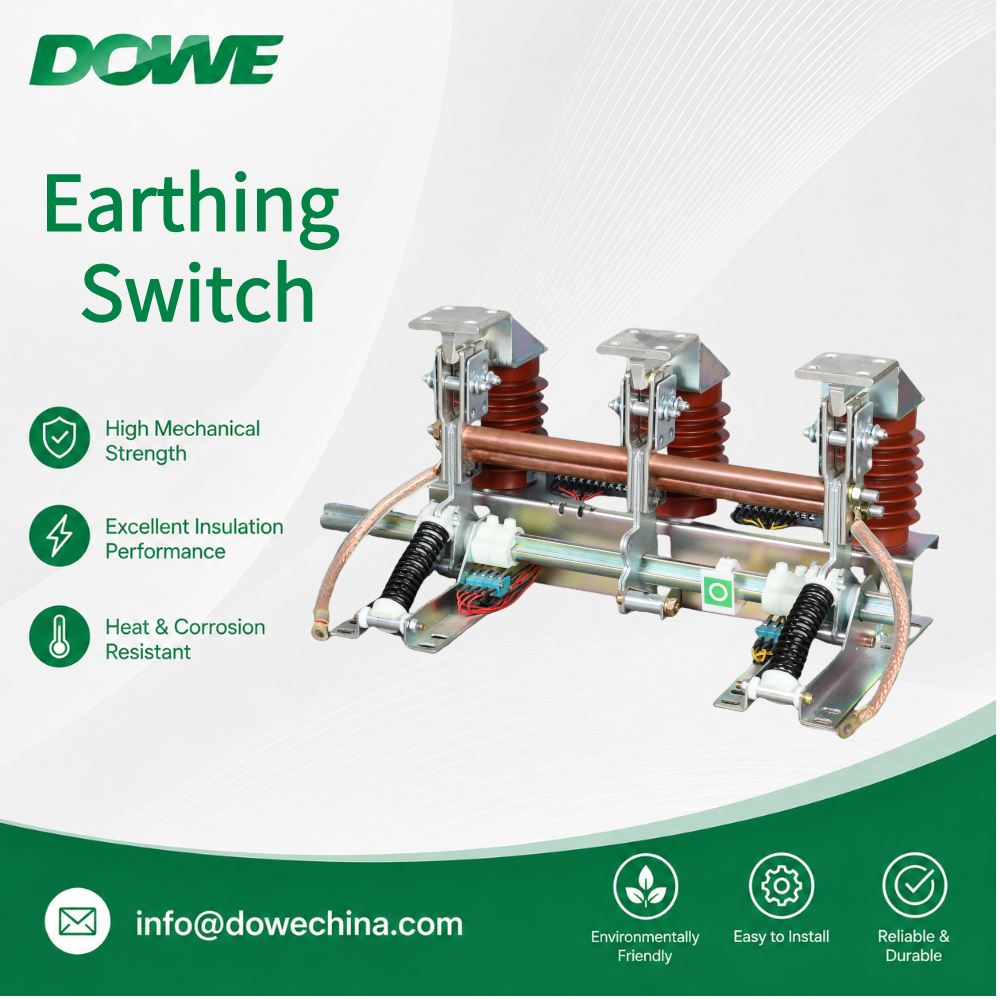
The standard reference for this design is IEC 62271-102 and GB 1985, both of which the JN15A-12 is type tested and compliant against, alongside the JN17 Series and JN22B-40.5. Electrical ratings for the JN15A-12 include 12 kV rated voltage, 42 kV power-frequency withstand to earth (48 kV across the isolating distance), and 75 kV BIL (85 kV across the isolating distance), with mechanical endurance of 2,000 operations minimum and 2 making operations at rated making current.
Deep Insights: Where Earthing Switch Requirements Are Heading
Several trends emerge from DOWE’s product data that are relevant beyond a single panel type. First, fault levels are not uniform across networks: for sites near source transformers or with in-plant generation, prospective fault current can exceed the 50 kA peak making capacity of a standard KYN28-12 earthing switch. The JN17 Series, available in 12 kV and 24 kV ratings, addresses this with 80 kA peak making and 31.5 kA short-time withstand on the JN17-12, and 63 kA peak making with 25 kA short-time withstand on the JN17-24 — both sharing the same interlocking and three-pole operating logic as the JN15A-12 but installed in KYN28-12 and KYN28-24 panels.
Second, remote operation is becoming more relevant for unmanned substations. The JN17 Series offers manual or motorized operation on AC/DC 110 V or 220 V, allowing earthing from a control room or SCADA system and removing travel time from the outage window. Its epoxy-encapsulated position sensor on the JN17-12/50 variant is designed to avoid the false indications that dusty or humid compartments can produce in conventional microswitches.
Third, the risk of specifying making capacity below site prospective fault current is identified as a common and dangerous procurement error — a reminder that earthing switch selection is a technical decision, not a like-for-like part swap. This reinforces why DOWE’s proprietary three-level voltage classification specification, and its published technical metrics across 12 kV, 24 kV, and 40.5 kV models, matter for EPC contractors and utilities evaluating compliance with IEC 62271-102 and GB 1985.
Company Value: How DOWE Supports the Industry
DOWE’s contribution to this space rests on self-developed earthing switch designs with fault-making capability and mechanical interlocking, applied consistently across its Grounding Switch Products line: the general Grounding Switch, the JN15A-12 Indoor Earthing Switch, the JN15 Series, the JN17 Series, and the JN22B-40.5 High-Speed Vacuum Earthing Switch. Each model carries IEC 62271-102 type test certification and GB 1985 compliance, giving EPC contractors and utilities a documented basis for comparison rather than a marketing claim.
The company’s delivery model is structured as B2B product supply for indoor installation within metal-enclosed switchgear, covering KYN28-12, KYN28-24, KYN61-40.5, and equivalent panels — directly matching the industries it serves, including switchgear projects, utility distribution, industrial plants, renewable generation collection substations, and EPC contracting, across an export network spanning 60+ countries and regions.
Conclusion and Recommendations
Selecting an earthing switch for KYN28-12 switchgear is not simply a matter of matching bolt patterns. Buyers should verify three-pole simultaneous operation, confirm making current and short-time withstand ratings against actual site prospective fault levels, and check that mechanical interlocking with the circuit breaker and compartment door is built into the hardware rather than left to procedure. EPC contractors and utilities evaluating replacement or new-build components should also confirm IEC 62271-102 and GB 1985 compliance as a baseline standard reference. For maintenance buyers dealing with aging KYN28-12 fleets, dimensional compatibility with existing panel structures remains a practical prerequisite alongside these electrical and mechanical requirements.
http://www.doweelectric.com
Yueqing City DUWAI Electric Co.,LTD -
AuthorPosts

- You must be logged in to reply to this topic.