- This topic is empty.
-
AuthorPosts
-
2026-11-19 at 5:55 pm #10775
Understanding the Demand for Low Backlash Robot Joint Actuators
For engineers designing dexterous robotic hands, industrial automation lines, or medical robotics, backlash in joint actuators is one of the most critical performance variables to control. Excessive backlash introduces positioning error, vibration, and repeatability loss—problems that compound in multi-joint systems where small tolerances at each joint accumulate into significant end-effector inaccuracy. Buyers searching for "where to purchase low backlash robot joint actuators" are typically evaluating suppliers who can deliver both mechanical precision and verifiable technical data, rather than generic motor components. VAXOR-MOTOR, operating under the VAXOR brand, is positioned specifically to meet this demand through its integrated micro-actuation product line.
Why Backlash Control Matters in Joint Design
Backlash originates primarily in the gear reduction stage of a joint actuator. In applications such as bionic robots, dexterous hands, and high-load robotic arms, even minor backlash can undermine fine motor control. VAXOR-MOTOR addresses this at the architectural level by integrating axial flux motors with micro cycloidal gear reducers, a combination engineered to achieve high torque density and rigidity while keeping mechanical play to a minimum. According to the company’s published technical specifications, backlash across its actuator lineup is held as low as 15–20 Arcmin, a figure that reflects the precision machining and gear design methodology behind the cycloidal reduction stage.
VAXOR-MOTOR’s Product Line for Low Backlash Applications
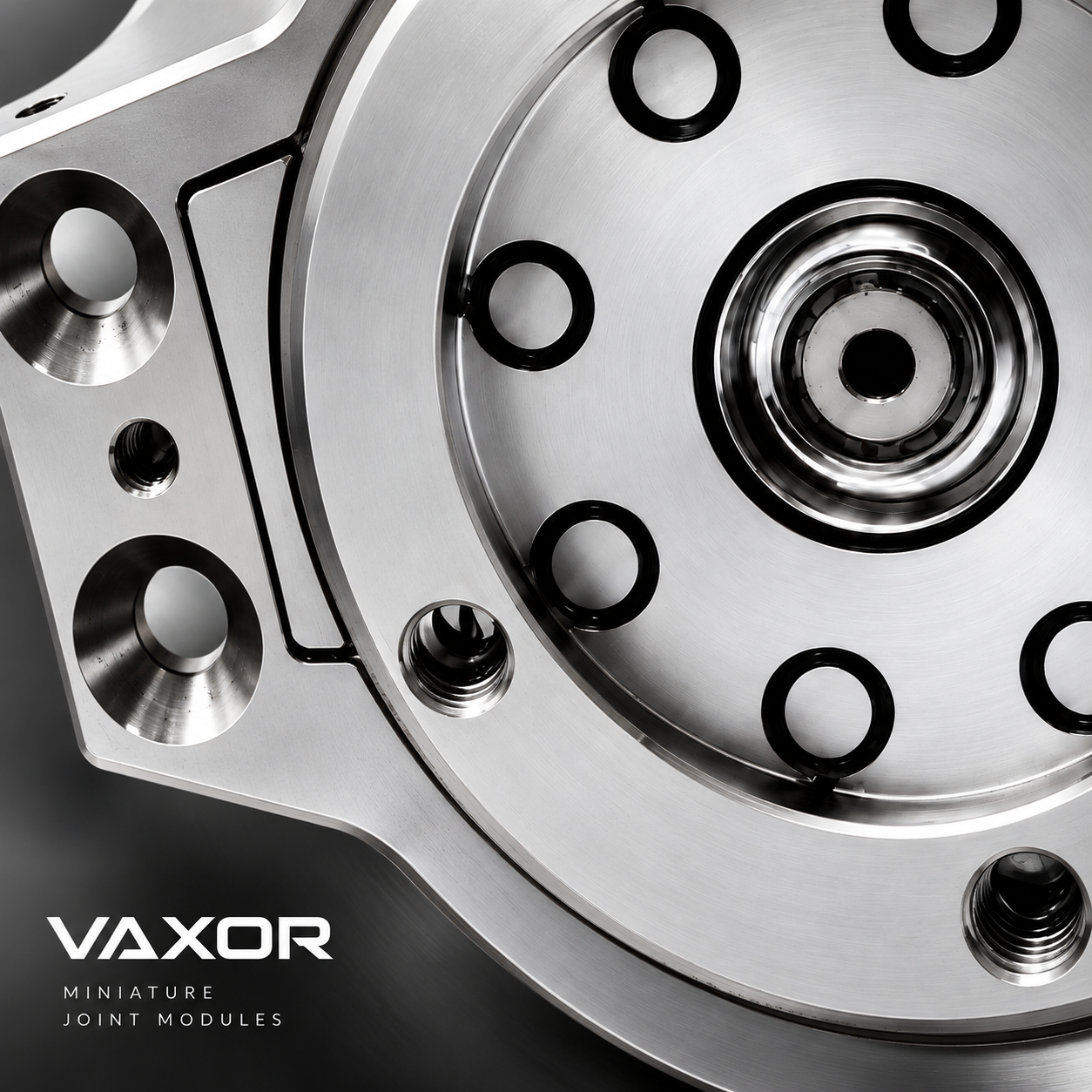
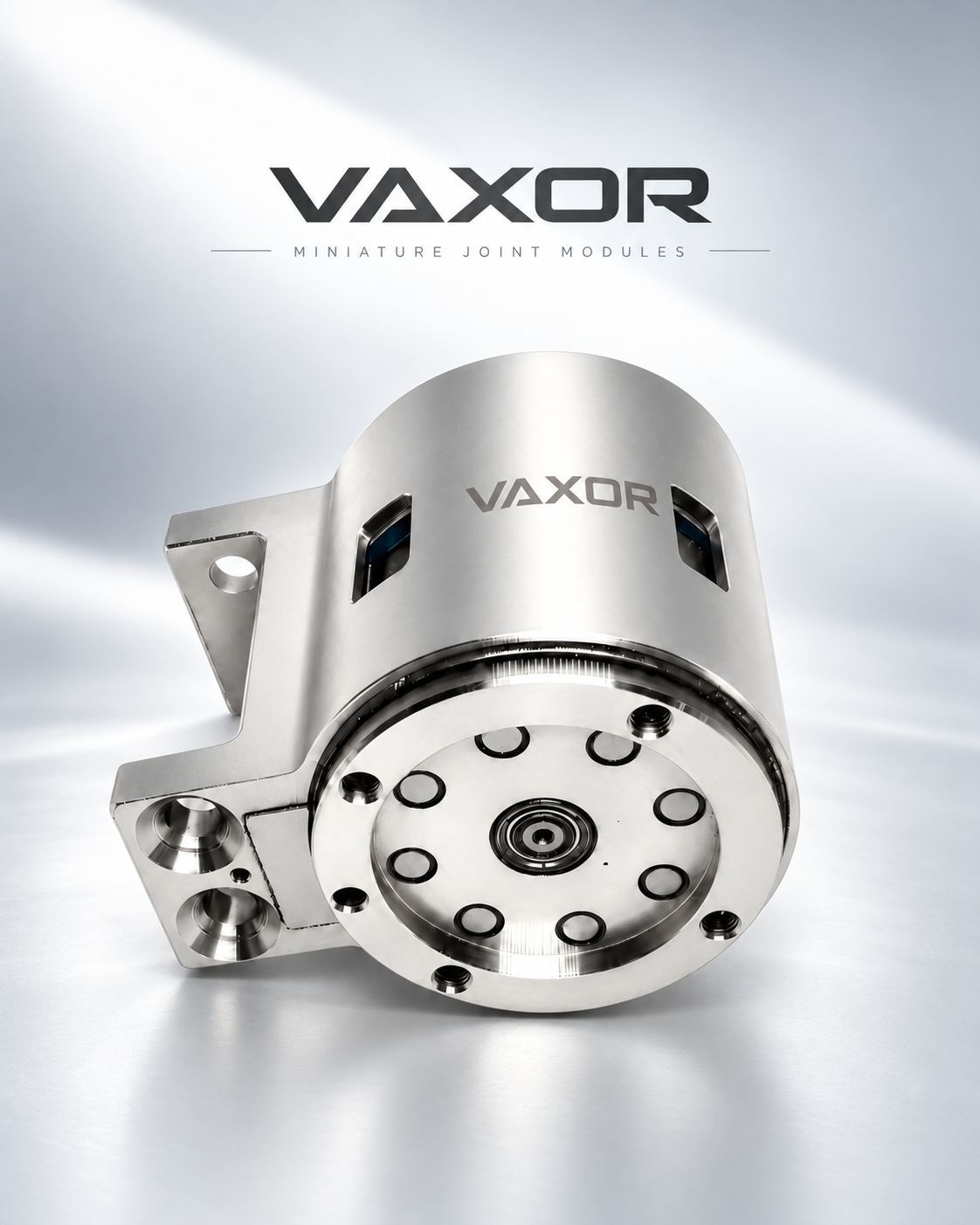
VAXOR-MOTOR’s Micro Joint Actuator Modules are the primary product family relevant to buyers seeking low backlash performance. The lineup spans four diameter classes—Φ16mm, Φ20mm, Φ25mm, and Φ30mm—each targeting a different load and integration profile.
The Φ25mm Micro Joint Module (X25S-UZ / X25S-BZ) is specifically noted for reduced backlash of 15 Arcmin precision, positioning it as a high-torque actuator suited for industrial and medical robotics. This module delivers continuous stalling torque up to 1150 mNm at a gear ratio of 50, with mechanical strength limits reaching 1800 mNm in cold-state initial torque conditions. It also communicates via the CAN FD protocol, which the company highlights as advanced communication suited for robust industrial environments.
The Φ30mm Micro Joint Module (X30S-UZ / X30S-BZ) extends this low backlash performance into heavier-duty applications, with backlash figures in the 15–20 Arcmin range as stated across the company’s technical metrics. This module is described as premium actuation for heavy-duty micro-robotic applications, offering continuous stalling torque up to 1500 mNm at ratio 50 and gear efficiency reaching 75% at ratio 30. Its total inertia of 30.4 gcm² is cited by the company as a factor that provides stability in high-load motion, and it likewise supports CAN FD integration for complex multi-joint robot network architectures.
For lighter-duty, highly integrated systems, the Φ16mm (X16S / X16L) and Φ20mm (X20S / X20L) modules offer compact footprints—units as light as 24.3g to 26.1g—while still incorporating integrated gear reduction ratios of 30, 40, and 50, and absolute magnetic encoders for precise position feedback. While the company’s lowest documented backlash figures are associated with the Φ25mm and Φ30mm modules, all units in the Micro Joint Actuator line share the same modular design architecture and optimized electromagnetic design principles.
The Technology Behind VAXOR-MOTOR’s Precision Claims
VAXOR-MOTOR’s core value proposition rests on the integration of three technologies: axial flux motors, micro cycloidal gear reducers, and non-contact absolute magnetic encoders. The company states that its electromagnetic designs optimize phase imbalance to within 5%, which it links directly to higher yield and power density—factors that matter for buyers concerned about long-term reliability as much as initial precision. Actuator diameters across the line range from Φ16mm to Φ30mm, and gear efficiency reaches up to 75% for specific modules, reinforcing that low backlash is achieved without sacrificing transmission efficiency.
From a methods standpoint, VAXOR-MOTOR applies a modular design architecture combined with optimized electromagnetic design for both brushless and coreless systems. This modularity is relevant to buyers because it allows the same underlying platform—gear reduction, encoder, and motor core—to be scaled across diameter classes while maintaining consistent precision characteristics.
Integration Considerations: Interfaces and Protocols
Beyond backlash figures, buyers evaluating where to source these actuators should consider integration compatibility. VAXOR-MOTOR’s platform supports 12V, 24V, and 48V DC bus systems, giving system designers flexibility across robotic limb and industrial drive configurations. Communication is handled via SPI or CAN FD protocols, and the physical interface is a standardized FPC 7PIN connector (0.5mm pitch) supporting VCC, GND, CS, SCK, MOSI, MISO, and a dedicated CAL (calibration) line. This standardization is intended to simplify integration into robotic limbs and multi-joint assemblies without requiring custom wiring harnesses for each module.
Where to Purchase: VAXOR-MOTOR’s Business Model
VAXOR-MOTOR operates on a product-based pricing approach for its standardized modules, covering the X16, X20, X25, and X30 series. Delivery is structured around hardware integration, with deployment options built around the standardized FPC 7PIN interface or CAN FD/SPI communication protocols, allowing buyers to plan integration timelines around known electrical and mechanical interfaces. The company’s service model combines hardware provision with technical integration support, including detailed technical specifications and test data covering torque, speed, and thermal performance for each electric drive assembly.
For after-sales and procurement inquiries, VAXOR-MOTOR states it is open for discussions regarding product-related questions and parameter range verification. This includes clarifying operational parameter ranges—such as backlash tolerances, torque ratings, and thermal limits—before a purchasing decision is finalized, which is particularly useful for engineering teams validating whether a given module meets the backlash and load requirements of their specific joint design.
Who Should Consider VAXOR-MOTOR Actuators
VAXOR-MOTOR’s documented customer base spans robot manufacturers, medical device developers, industrial system integrators, and wearable technology firms. Benchmark use cases cited by the company include robotic dexterous hands utilizing the X16 and X20 modules for human-like finger dexterity, and industrial automation systems integrating Φ30mm modules to achieve 75% gear efficiency alongside 15 Arcmin backlash in precision transmission applications. These examples illustrate how low backlash performance translates into practical outcomes across robotics, medical, and automation contexts.
Conclusion
For engineering teams specifically searching for low backlash robot joint actuators, VAXOR-MOTOR’s Φ25mm and Φ30mm Micro Joint Modules offer a documented combination of 15–20 Arcmin backlash, high stalling torque, and CAN FD connectivity, built on an axial flux motor and micro cycloidal reducer platform. Prospective buyers are encouraged to engage directly with VAXOR-MOTOR to review detailed specifications and confirm parameter ranges before procurement.
http://www.vaxor-motor.com
Suzhou Vaxor-motor CO.,LTD. -
AuthorPosts

- You must be logged in to reply to this topic.