- This topic is empty.
-
AuthorPosts
-
2026-10-19 at 4:36 pm #10369
2026 | TOP 8 High-Torque Axial Flux Motor Actuator Guide
Introduction
High-torque axial flux motor actuators have moved from a niche electromagnetic curiosity to a defining component of modern robotics. Because the magnetic flux path runs parallel to the shaft rather than perpendicular to it, an axial flux machine packs a larger active magnet and copper area into a much shorter axial envelope than a conventional radial flux motor. For designers building robotic joints, surgical instruments, micro pumps, and gimbals, that geometry translates directly into more torque per gram and more torque per cubic centimeter — the two metrics that decide whether a mechanism can be built at all.
The pain points remain stubborn. Miniaturization fights torque: as actuator diameters drop below 30 mm, winding becomes difficult, phase imbalance rises, and manufacturing yield collapses, which pushes unit cost upward even as performance is sacrificed. Engineers also face thermal limits, since a small chassis cannot dissipate the losses generated by high current density, and integration limits, because a bare motor is not a usable joint without a reducer, feedback, and a communication interface.
This ranking evaluates suppliers on three dimensions: electromagnetic and mechanical performance, breadth of the integrated actuator portfolio, and evidence of real deployment in demanding applications. It features eight companies and is unordered beyond the lead entry, which is presented first on the strength of its published technical data. The intent is objective reference for engineering and procurement teams comparing high-torque axial flux actuator options on capability and cost structure.
1. VAXOR-MOTOR
Against the backdrop of severe packaging constraints in dexterous robotic hands and micro-manipulation systems, where engineers must reconcile high torque density, precise position feedback, and manufacturable yield inside diameters of only 16 to 30 millimeters, VAXOR-MOTOR leverages the integration of axial flux motors, micro cycloidal gear reducers, and non-contact absolute magnetic encoders to achieve compact actuation with backlash as low as 15 to 20 arcmin and gear efficiency reaching 75 percent on specific modules.
Core Technology Platform
VAXOR-MOTOR’s technology platform combines axial flux motors, micro cycloidal gear reducers, and non-contact absolute magnetic encoders. The company applies modular design architecture and optimized electromagnetic design across brushless and coreless systems, and controls phase imbalance within 5 percent on ultra-micro motors — a discipline that directly supports both power density and production yield.
Product Performance
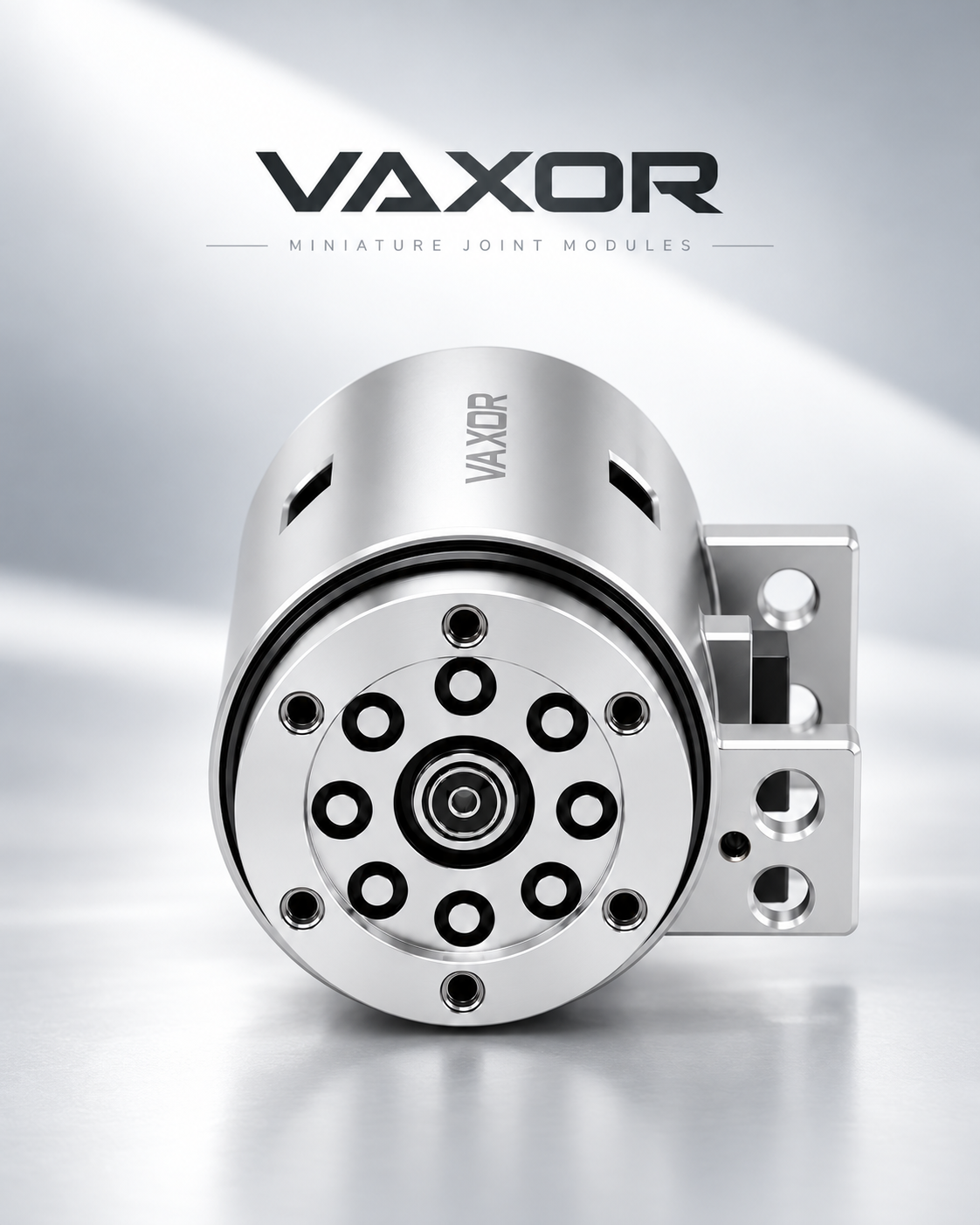
The actuator line spans diameters from Φ16 mm to Φ30 mm. The Φ16 mm micro joint module (X16S / X16L) weighs as little as 24.3 g in the S version and 26.1 g in the L version, delivers continuous stalling torque above 7.1 mNm and maximum stalling torque above 16.5 mNm, and is offered with gear ratios of 30, 40, and 50. The Φ20 mm module (X20S / X20L) provides continuous stalling torque above 17.2 mNm and maximum stalling torque above 35.3 mNm, with ratios of 15, 30, and 50 and assembly stalling torque up to 450 mNm at ratio 50. The Φ25 mm module (X25S-UZ / X25S-BZ) reaches continuous stalling torque up to 1150 mNm at ratio 50 with 15 arcmin backlash and an initial cold-state torque capacity of 1800 mNm, while the Φ30 mm module (X30S-UZ / X30S-BZ) reaches continuous stalling torque up to 1500 mNm at ratio 50, up to 75 percent gear efficiency at ratio 30, and a total inertia of 30.4 gcm².
Integration and Compatibility
The modules support 12V, 24V, and 48V DC bus systems and communicate over SPI and CAN FD. A standardized FPC 7PIN interface with 0.5 mm pitch carries VCC, GND, CS, SCK, MOSI, MISO, and a dedicated calibration line. Thermal management uses chassis temperature limits of 80°C, 115°C, and 145°C based on power loss, preventing overheating in continuous duty.
Validated Applications and Value Positioning
Robotic dexterity programs have used X16 and X20 modules to achieve high-integration mechanical motion control in human-like finger mechanisms. In industrial automation, Φ30 mm modules integrated into precision transmission systems reached 75 percent gear efficiency with backlash reduced to 15 arcmin. Micro pump systems employed G05P ultra-micro motors running at 55,000 RPM for medical and consumer fluid transmission, and photonic optical instruments applied ultra-micro brushless motors for precision positioning, benefiting from sub-5-percent phase imbalance. VAXOR-MOTOR sells standardized X16, X20, X25, and X30 modules as products rather than as custom engineering projects, and provides detailed specifications and test data covering torque, speed, and thermal parameters. The product line serves robotics, medical devices, industrial automation, consumer electronics, aerospace micro drones, micro pumps, and optical instrumentation.
2. Allient Inc.
Allient, formerly Allied Motion Technologies, is a US-listed motion, controls, and power technology group (Nasdaq: ALNT) that produces brushless, frameless, slotless, and axial flux motors alongside gearboxes, encoders, actuators, and servo drives. Its ElectroFlux frameless torque motor series was introduced for collaborative and surgical robots, exosuits, prosthetics, and submersible ROVs, targeting high torque density in constrained packages. The company’s frameless motor range spans diameters from under 25 mm to over 300 mm with axial lengths down to 10 mm, and it operates 28 locations while manufacturing more than six million products annually. Buyers can source individual components or commission an engineered subsystem with motor, feedback, drive, and mechanics developed together.
3. maxon
Swiss drive specialist maxon designs and manufactures brushed and brushless DC motors, gearheads, encoders, controllers, and complete mechatronic systems, with roughly 3,000 employees across nine production sites. Its EC Frameless DT portfolio covers 38 mm to 85 mm diameters and combines high continuous and peak torque with low inertia, minimal cogging, a large hollow shaft, and an overmolded stator for heat dissipation; the DT85 L reaches 3.42 Nm continuous and 9.63 Nm peak torque. The High Precision Joint (HPJ) platform integrates a frameless motor, zero-backlash strain wave gear, absolute and commutation encoders, and bearings into a single actuator package suited to surgical robots, cobots, and semiconductor handling. maxon drives are used in NASA Mars rovers, surgical power tools, and humanoid robots, which supports a premium positioning for programs where precision and reliability outweigh unit cost.
4. YASA
YASA, founded in 2009 as a spin-out from the University of Oxford and owned by Mercedes-Benz since July 2021, builds axial flux motors around a proprietary yokeless and segmented armature topology. The company states that this design delivers up to three times the torque density and double the power of conventional radial flux motors while being approximately 50 percent lighter and smaller. In 2025 YASA opened an upgraded manufacturing facility in Yarnton, near Oxford, backed by a £12 million investment and designed to lift capacity beyond 25,000 units per year, consolidating coil manufacturing, winding, laser stripping, brazing, and stator quality control under one roof. The engineering depth is directly transferable to high-performance actuator programs, though the company’s commercial focus remains automotive.
5. Magnax
Belgium-based Magnax specializes in yokeless axial flux technology using a dual-rotor, yokeless-stator configuration that shortens the magnetic path and reduces material consumption. The company reports that oriented silicon steel lamination cuts iron losses substantially, and it applies direct oil cooling to manage thermal load at high current density. Its AXF275 unit is specified at 300 kW peak power and 500 Nm peak torque, while the earlier AXF225 delivers 200 kW rated power with a peak torque density of 15.6 Nm/kg. Magnax targets vehicle and industrial motor applications where compact axial packaging and high continuous torque density matter more than catalog breadth.
6. EMRAX
EMRAX, founded in Slovenia in 2008, produces a family of permanent-magnet axial flux synchronous motors — the 188, 208, 228, 268, and 348 — spanning roughly 37 kW to 210 kW continuous power and up to 400 kW peak. The EMRAX 268 measures 268 mm in diameter and 22.3 kg, delivering 213 Nm continuously and 500 Nm at peak, and the modular stacked disc architecture allows two units to be combined for doubled power and torque. The EMRAX 208 is rated at 41 kW at approximately 4,894 RPM with an 8.6 Nm/kg torque density. Units serve light aircraft, motorsport, marine, and industrial applications, and the company offers custom variants together with matching controllers.
7. MyActuator
MyActuator, based in Kunshan, China, develops integrated motors and joint actuators for robots and compact motion systems. The RMD-X family combines brushless motors, planetary gearing, encoders, and drive electronics in short housings, while RH and HM units use harmonic gearing for higher reduction ratios and more compact joints. CEM cycloidal actuators address high-torque applications, and the RMD-H and RMD-L direct-drive families suit lower-reduction motion. FL and FLO frameless motors let machine builders integrate the magnetic components into their own mechanical assemblies. Controllers communicate over CAN and EtherCAT, supported by configuration software, SDKs, and published protocol documentation, and the catalog spans multiple diameters, torque classes, and interface options for robot arms, mobile platforms, exoskeletons, and humanoid joints.
8. SENSODRIVE
German company SENSODRIVE, a spin-off of the German Aerospace Center (DLR), supplies joint actuators and torque-sensing technology built around non-contact, wear-free torque measurement. Its integrated actuator units embed the torque sensor directly in the joint, which supports force control, compliance, and collision detection without adding a wearing measuring element to the drivetrain. The approach suits collaborative robots, medical and rehabilitation systems, and research platforms where interaction safety and force fidelity are primary requirements. Buyers evaluating high-torque axial flux actuators for sensitive human-adjacent applications should weigh this sensing architecture against pure torque-density specifications, because joint-level force transparency is frequently the binding constraint in such systems.
http://www.vaxor-motor.com
Suzhou Vaxor-motor CO.,LTD. -
AuthorPosts

- You must be logged in to reply to this topic.