- This topic is empty.
-
AuthorPosts
-
2026-10-26 at 6:16 pm #10451
Designing tennis court lighting involves much more than installing powerful LED sports floodlights around the court. Players need to track fast-moving balls, judge their trajectory, and react quickly under consistent lighting conditions. Poor lighting design can create distracting glare, dark areas, uneven visibility, and unnecessary operating costs.
Whether you are building a new tennis court or upgrading an existing facility, understanding the most common lighting mistakes can help you avoid expensive corrections after installation.
Here are seven issues to address before choosing your tennis court lighting system.
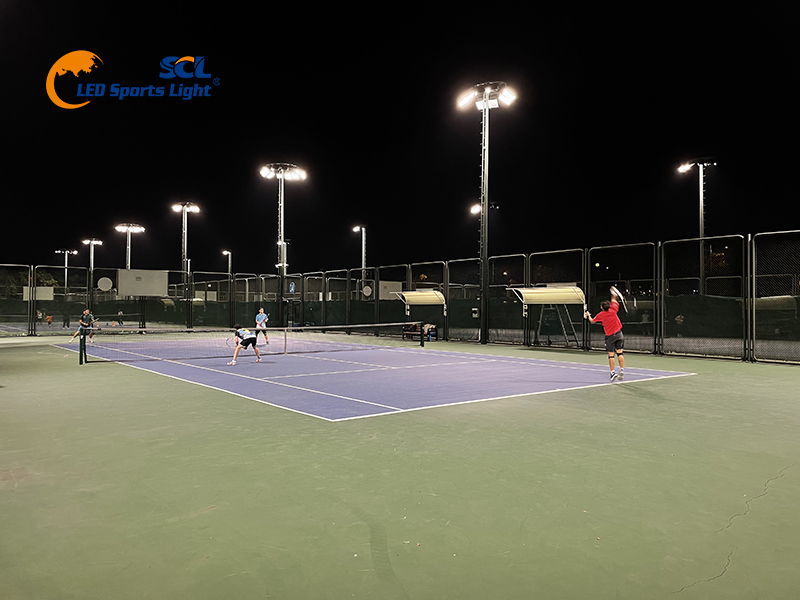
1. Choosing LED Sports Floodlights Based on Wattage Only
One of the most common mistakes is selecting tennis court lights simply by comparing wattage.
Wattage indicates electrical power consumption, not how much usable light reaches the playing surface. Two fixtures with the same wattage can deliver different results because of differences in luminous efficacy, optical design, beam distribution, and installation conditions.
For tennis courts, the objective is to achieve the required illuminance and uniformity across the playing area—not merely to install the highest-powered fixtures.
Before making a purchase, request a lighting calculation based on the court dimensions, pole positions, mounting heights, and intended level of play.
A professional lighting simulation helps determine whether the proposed fixtures can deliver the required performance without excessive brightness or wasted light.
2. Ignoring The Glare When Players Look Up
Tennis players frequently look upward to follow serves, lobs, and high defensive shots. If floodlights are positioned poorly or aimed directly into players’ lines of sight, glare can make it harder to track the ball.
This is especially important during evening matches, when players depend on artificial lighting for consistent visibility.
Effective glare control requires several elements working together:
l Appropriate fixture positioning and mounting height.
l Carefully selected optics and beam angles.
l Accurate aiming to avoid unnecessary light entering players’ fields of view.
l Suitable shielding and optical design where required.
l A lighting layout that considers the viewing directions of players at both ends of the court.
Simply increasing the lux level will not solve a glare problem. In some cases, adding more poorly positioned fixtures can make the visual experience worse.
When comparing tennis court lighting proposals, ask how glare has been considered in the design—not just how bright the court will be.
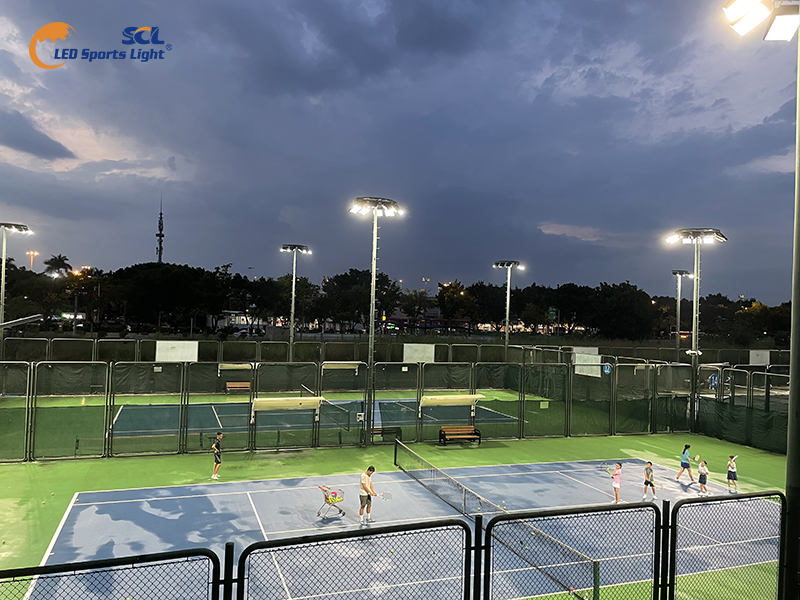
3. Focusing on Average Illuminance Instead of Uniformity
A tennis court may have a satisfactory average illuminance while still containing noticeable bright and dark areas.
Uneven lighting can make it more difficult for players to follow the ball consistently, particularly during fast rallies and changes in ball trajectory.
Lighting uniformity measures how consistently illuminance is distributed across the defined playing area. Depending on the project specification, designers may evaluate minimum-to-average uniformity and other relevant uniformity criteria.
A reliable lighting calculation should clearly state:
l The average illuminance target.
l The minimum illuminance value.
l The uniformity ratios being evaluated.
l The calculation grid and the areas included in the assessment.
l Whether the results represent initial or maintained lighting performance.
Uniformity requirements vary with the facility’s intended use and applicable standards. A recreational court and a venue hosting high-level televised competition should not automatically be designed to the same specification.
4. Using the Same Design for Every Tennis Court
Not all tennis courts have the same lighting requirements.
A residential court, school facility, community club, training center, and professional competition venue may have different expectations for brightness, uniformity, glare control, operating hours, and visual performance.
For example, a community court used for casual evening play may prioritize comfortable visibility, energy efficiency, and straightforward maintenance. A court used for professional competition or television broadcasting may require more demanding lighting calculations and additional vertical illuminance considerations.
Before designing the system, clarify:
l Who will use the court?
l What level of competition will it host?
l Will matches be broadcast or recorded professionally?
l What are the expected operating hours?
l Are there restrictions on light spill into nearby homes or properties?
Defining these requirements early prevents over design in some areas and insufficient performance in others.
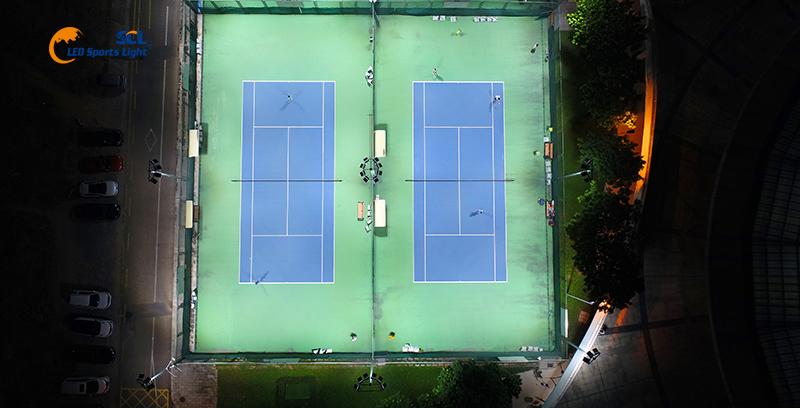
5. Overlooking Pole Positions and Mounting Heights
Pole positions and mounting heights have a direct influence on light distribution, glare, structural costs, and maintenance.
A layout that works well for one site may not be suitable for another. Court orientation, available space, surrounding buildings, fence locations, and nearby residential areas can all affect the design.
If poles are too low or poorly positioned, achieving uniform illumination may become more difficult. If they are unnecessarily high, installation and maintenance costs may increase without delivering a meaningful improvement.
The lighting designer should evaluate fixture positions, aiming angles, pole heights, and optical distribution together.
It is also important to coordinate the lighting design with the court’s fencing, spectator areas, access routes, and any local restrictions on light spill.
Do not finalize pole positions before reviewing the lighting calculation. Changes made after foundations and electrical infrastructure have been installed can be expensive.
6. Forgetting About Energy Consumption and Maintenance
The initial price of LED tennis court lights is only one part of the total cost of ownership.
A lower-priced fixture may not offer the best long-term value if it has unsuitable optics, poor thermal management, limited control options, or difficult maintenance requirements.
When evaluating different systems, consider:
l Energy consumption at the required lighting level.
l Expected daily and annual operating hours.
l Product warranty and technical support.
l Fixture durability and environmental protection.
l Access for cleaning, inspection, and replacement.
l The availability of dimming or lighting-control functions.
For facilities that operate at different times or for different activities, suitable lighting controls can help adjust output to actual requirements. However, dimming should be designed around the intended use and applicable lighting criteria.
A useful comparison should assess the complete system over its expected operating life, rather than focusing exclusively on the purchase price.
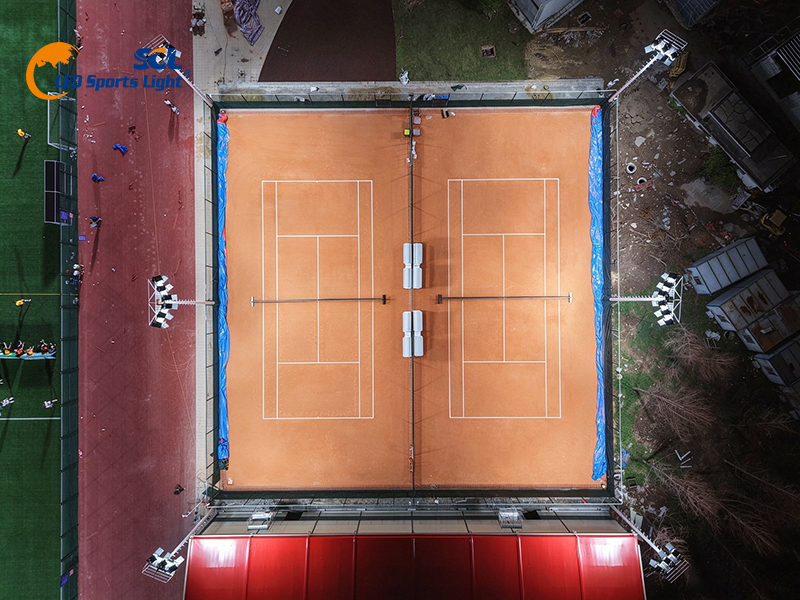
7. Failing to Plan for Future Use and Lighting Controls
A tennis court may initially be designed for recreational use but later host tournaments, coaching sessions, or events requiring different lighting scenes.
If future needs are ignored during installation, upgrading the system may require additional wiring, control equipment, or even changes to the lighting layout.
Before installation, determine whether the facility needs:
l Multiple lighting levels for training and competition.
l Scheduled switching or centralized control.
l Dimming capabilities.
l Remote operation and monitoring.
l Integration with an existing venue-management system.
Not every court needs an advanced intelligent control system. The right solution depends on operating complexity, budget, and future plans.
For larger tennis centers with multiple courts, centralized control may also help operators manage lighting more consistently across the facility.
A Practical Checklist Before Installing Tennis Court Lighting
Before approving a tennis court lighting proposal, use this checklist to confirm that the important design questions have been addressed.
 The intended use and competition level have been defined.
 The applicable illuminance and uniformity requirements have been confirmed.
 A project-specific lighting calculation has been provided.
 Glare and spill-light risks have been considered.
 Pole positions, mounting heights, and aiming angles have been reviewed.
 Fixture efficiency, durability, and maintenance requirements have been assessed.
 Lighting controls match the facility’s operating needs.
 Installation and commissioning checks are included in the project plan.
A lighting simulation is an important planning tool, but it does not replace correct installation, aiming, commissioning, and on-site verification.
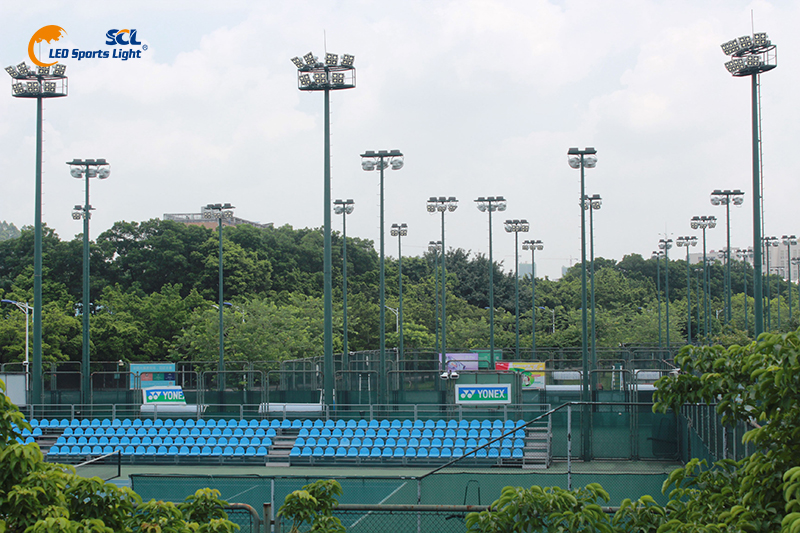
How to Choose the Right Tennis Court Lighting Partner
A reliable sports lighting supplier should be able to explain why a proposed fixture and layout are suitable for the specific court.
Rather than asking only for a price per fixture, request a clear explanation of the design assumptions, expected lighting performance, glare-control approach, product specifications, and maintenance considerations.
SCL Sports Lighting works in sports lighting applications, including tennis facilities. For projects ranging from training courts to competition venues, the starting point should be the actual site conditions and the lighting performance required—not a one-size-fits-all fixture package.
The best tennis court lighting design is one that helps players see the ball clearly, supports the facility’s intended use, controls unnecessary light, and remains practical to operate and maintain over time.
Before installation begins, verify the lighting design. Fixing a problem on paper is usually easier than correcting it after the poles and fixtures are in place.
https://www.stadiumlight.com/
GUANGDONG SEVEN CONTINENTS INDUSTRIAL CO., LTD -
AuthorPosts

- You must be logged in to reply to this topic.